Noor Trends News, Technical Analysis, Educational Tools and Recommendations

President Donald Trump expressed frustration after financial markets sold off despite a much stronger-than-expected US jobs report, arguing that stocks should have rallied on evidence of a resilient economy.
The reaction highlighted a growing disconnect between economic strength and investor sentiment, as markets increasingly focus on what robust data could mean for future interest-rate policy rather than celebrating signs of continued growth.
The latest employment report showed that the US economy added 172,000 jobs in May, far exceeding expectations. At the same time, April’s payroll figures were revised sharply higher, reinforcing the view that the labor market remains in considerably better shape than many analysts had anticipated.
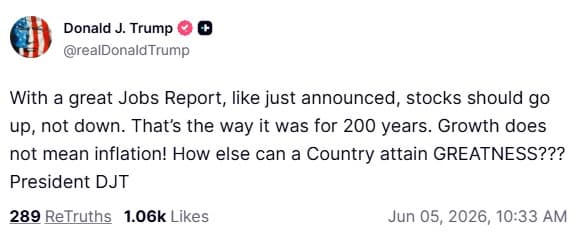
Trump pointed to the strong hiring figures as evidence that the economy continues to perform well and questioned why major stock indexes were falling instead of rising.
Strong Labor Market Fuels Concerns Over Interest Rates
While the jobs data underscored economic resilience, investors interpreted the report differently.
A stronger labor market reduces pressure on policymakers to lower interest rates and may even strengthen the case for maintaining restrictive monetary policy for a longer period. Some investors also fear that persistent economic strength could complicate efforts to bring inflation fully under control.
As a result, financial markets rapidly reassessed expectations for future policy decisions.
The stronger-than-expected employment report pushed Treasury yields higher and boosted the US dollar, creating headwinds for equities and other risk-sensitive assets.
Nasdaq Leads Broad Market Decline
Wall Street responded negatively to the employment surprise.
The technology-heavy Nasdaq Composite fell more than 2%, while the broader S&P 500 also posted notable losses. The Dow Jones Industrial Average declined as investors digested the implications of a labor market that continues to outperform expectations.
Technology stocks were particularly vulnerable because higher interest rates tend to reduce the appeal of growth-oriented companies whose valuations rely heavily on future earnings expectations.
The selloff demonstrated a familiar market dynamic in which positive economic news can trigger concerns about tighter monetary policy.
Trump’s Economic Argument Meets Market Reality
Trump’s comments reflected a straightforward economic argument: strong job creation, rising employment, and a healthy economy should support higher stock prices.
However, markets are currently operating under a different framework.
Investors increasingly believe that strong economic data could delay any future interest-rate cuts and potentially increase the likelihood of additional policy tightening if inflation remains elevated.
That means positive economic surprises are no longer guaranteed to produce positive market reactions.
Instead, traders are evaluating whether strong growth could keep borrowing costs higher for longer, a scenario that generally weighs on equity valuations.
Three Consecutive Strong Reports Change Expectations
The latest payroll figures marked another month of solid labor-market performance, extending a trend that has steadily challenged predictions of economic weakness.
Several consecutive reports showing stronger-than-expected hiring have reduced concerns about a significant slowdown in the US economy. At the same time, they have encouraged investors to reconsider assumptions that policymakers would soon begin a broad easing cycle.
The result has been a significant shift in market expectations, with traders increasingly preparing for an environment where interest rates remain elevated well into the future.
The Road Ahead
Markets will now focus on upcoming inflation data, Federal Reserve communications, and additional labor-market reports for clues about the direction of monetary policy.
If economic growth continues to exceed expectations while inflation remains stubborn, investors may further scale back expectations for rate cuts and increasingly price in a prolonged period of higher borrowing costs.
For Trump, the latest market reaction was a reminder that strong economic news does not always translate into rising stock prices. For investors, it reinforced the belief that interest-rate expectations remain the dominant force driving financial markets in 2026.