 Noor Trends News, Technical Analysis, Educational Tools and Recommendations

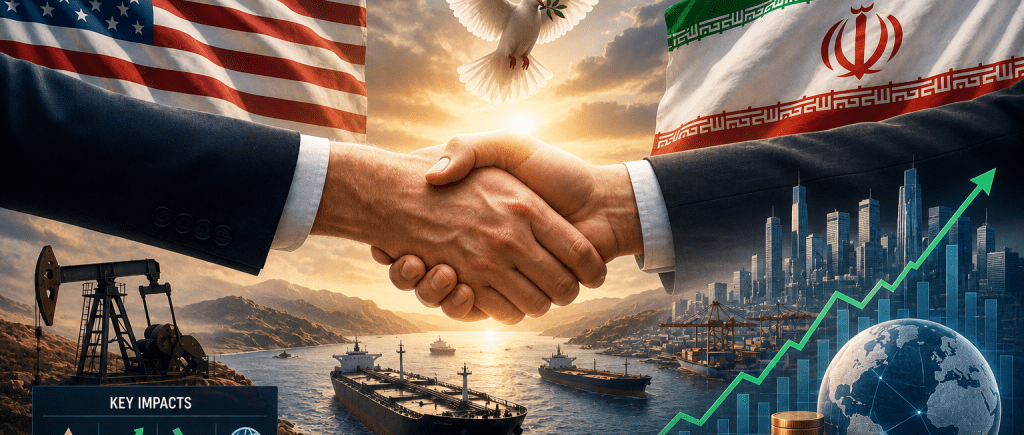
The newly signed understanding between the United States and Iran is being viewed as one of the most consequential geopolitical developments of 2026. By reducing tensions and paving the way for the reopening of key maritime trade routes, the agreement has immediately shifted the focus of investors, governments, and businesses from crisis management toward economic stabilization.
For months, global markets were dominated by fears of supply disruptions, rising energy costs, and escalating regional conflict. The new accord offers hope that some of those pressures may finally begin to ease, potentially providing a much-needed boost to an increasingly fragile global economy.
Energy Markets Gain a Breath of Fresh Air
The biggest and most immediate impact has been felt in energy markets. Uncertainty surrounding vital shipping lanes had driven oil prices sharply higher earlier this year, fueling concerns about inflation and economic slowdown across multiple regions.
With the agreement reducing the risk of further disruption, traders are increasingly betting on a more stable flow of oil and energy supplies. Expectations that additional Iranian crude could return to international markets have already helped cool price pressures, offering relief to both consumers and businesses worldwide.
Lower energy costs could also reduce transportation and manufacturing expenses, helping ease one of the major drivers of inflation that has troubled economies over the past several years.
A Potential Boost for Global Growth
The agreement arrives at a time when many economies are struggling with slower growth, elevated borrowing costs, and weak consumer confidence.
By reducing geopolitical uncertainty, the deal may encourage investment, improve trade conditions, and lower operating costs for businesses. Countries heavily dependent on imported energy stand to benefit particularly from any sustained decline in fuel prices.
Meanwhile, nations in the Middle East could gain from the return of more stable trade flows and improved economic activity. As supply chains normalize and shipping costs decline, businesses may find it easier to plan for expansion and long-term investment.
For global markets, the agreement represents more than a diplomatic breakthrough—it could become an important catalyst for renewed economic momentum.
Why Inflation Could Remain a Challenge
Despite the optimism, the agreement does not eliminate all economic risks.
While lower energy prices can help slow inflation, many of the underlying factors driving price pressures remain in place. Labor costs, housing expenses, and strong domestic demand continue to influence inflation trends in several major economies.
Central banks are therefore unlikely to declare victory too soon. Policymakers will continue monitoring economic data closely before making significant changes to interest-rate strategies.
As a result, investors should not expect the agreement alone to solve every inflation-related challenge facing the global economy.
The Real Test Lies Ahead
The true economic value of the agreement will depend on its durability. Markets have welcomed the reduction in tensions, but long-term confidence will require continued implementation and sustained diplomatic progress.
For now, the deal has removed one of the largest geopolitical threats hanging over the global economy. Whether it ultimately becomes a foundation for lasting stability or merely a temporary pause in uncertainty will shape market sentiment for months to come.
What is already clear is that the agreement has changed the conversation—from fears of escalating conflict to cautious optimism about recovery, growth, and a more stable economic future.