Noor Trends News, Technical Analysis, Educational Tools and Recommendations

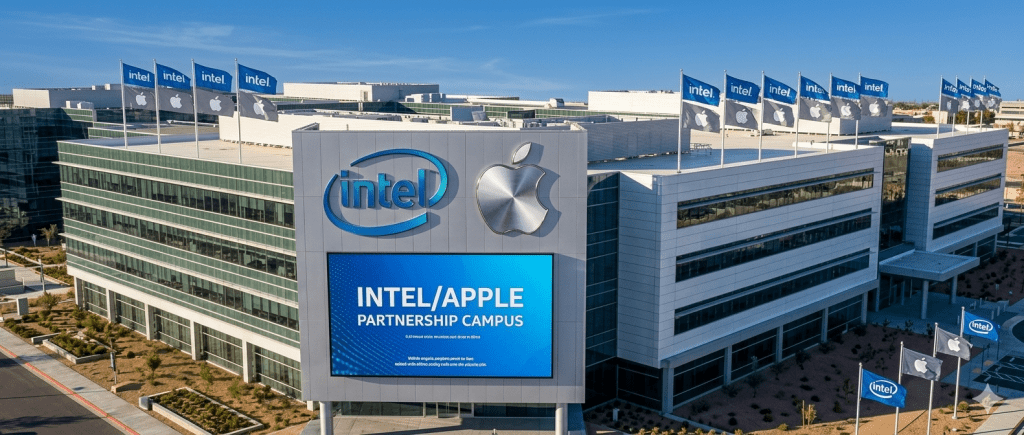
The landscape of the semiconductor industry is undergoing a radical transformation, reshaping the balance of power in the global market. Following a series of significant challenges, Intel appears to be on a path toward an extraordinary resurgence, bolstered by high-level political intervention and expectations of massive strategic partnerships that could place it back at the heart of the technological equation through a potential collaboration with Apple.
Restoring the Throne: Political Support and Strategic Intervention
Intel has passed through a pivotal phase that fundamentally altered its trajectory. Over the past year, the U.S. government became a strategic partner by acquiring a significant stake in the company, supported by massive investments.
This move was part of a national strategy to bolster domestic manufacturing, with Washington injecting billions of dollars through industrial stimulus legislation. This has helped transition Intel from a company struggling for survival into a cornerstone of American ambitions to dominate the chip market.
The Vision of Donald Trump and Elon Musk’s Plans
Former U.S. President **Donald Trump** has emerged as a primary driver of this shift. In statements shared on his social media platform, he confirmed that his administration succeeded in attracting major players, such as NVIDIA, to manufacture their first chips within the United States in collaboration with Intel.
Furthermore, Trump revealed arrangements for entrepreneur Elon Musk to participate in building a massive chip manufacturing facility dubbed “TerraFab.” This facility is planned to be the largest of its kind in the world, developed in partnership with Intel’s engineering teams. Despite the absence of granular technical details and a precise timeline, the market has reacted strongly to these signals, driving the company’s market valuation to record levels.
Technical Innovation: The Bet on the 18A-P Node
Intel is pinning its hopes on its advanced technology known as “18A-P,” which recently entered the risk production phase. This node represents a qualitative leap in performance, offering 18% higher energy efficiency, significantly improved heat dissipation, and an overall jump in processing power.
The technical challenge facing this alliance lies in the architectural differences: Intel has traditionally relied on the x86 architecture, while Apple builds its chips using the Arm architecture. Experts are closely watching how these two worlds will bridge this gap, with many suggesting that Apple’s commitment as a major client may be conditional on this new technology meeting the rigorous standards required for its hardware.
Financial Implications and Strategic Shift
While Intel’s foundry division is currently operating under financial pressure, bringing a giant like Apple into its client list could completely change the outlook for this sector. Such a move could potentially double the company’s annual revenue and transform its foundry arm from a financial burden into a sustainable growth engine, reinforcing investor confidence in the company’s long-term recovery strategy.
The Global Race: Clash of Titans in Arizona
There is no doubt that this alliance, if finalized, would create unprecedented competitive pressure on the companies currently dominating the market in Taiwan. The expansion of chip factories in Arizona, where Intel’s facilities sit in close proximity to massive investments from competitors, reflects the intensity of the struggle for technological sovereignty.
With direct political support, Intel now possesses a strategic advantage that could provide an edge in the global tech arms race, paving the way for a new era defined by localizing chip manufacturing as a top-tier security and economic priority.