Noor Trends News, Technical Analysis, Educational Tools and Recommendations

World Cup 2026: Who Really Wins When the Final Whistle Blows?
The numbers are staggering. The promises are even bigger. But behind the spectacle of the largest FIFA World Cup in history lies a far more complicated economic story — one that separates the tournament’s real winners from those left counting the costs.
The Biggest World Cup Ever — And the Highest Stakes
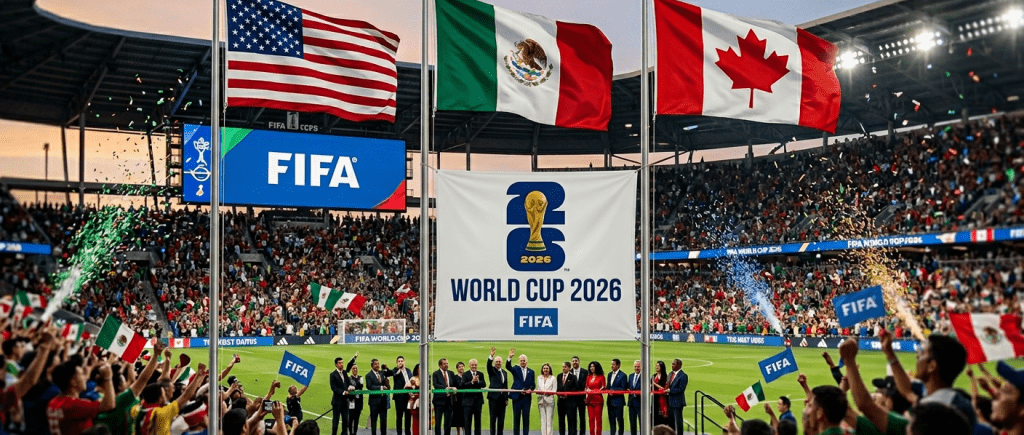
The 2026 FIFA World Cup is unlike anything football has seen before. For the first time in the tournament’s history, three nations share the hosting duties simultaneously: the United States, Canada, and Mexico. With 48 teams, 104 matches, and 16 host cities spread across an entire continent, the scale of the event is genuinely unprecedented.
Official projections paint a breathtaking picture. A joint study estimates the tournament will generate a global gross output of $80 billion, with a $40.9 billion contribution to world GDP. For the three host nations combined, the financial windfall is expected to reshape entire industries — from hospitality and transportation to retail and real estate.
But beneath these headline figures, economists and independent analysts are telling a very different story. The gap between what was promised and what will likely be delivered is wide — and it varies dramatically from one host country to the next.
Mexico: Infrastructure Investment With Limited Returns
Mexico is hosting 13 of the tournament’s 104 matches, spread across Mexico City, Monterrey, and Guadalajara. In preparation, the country made substantial infrastructure investments that deserve recognition.
The most significant project is the expansion of the Metrorrey system in Nuevo León, where new metro lines and the rehabilitation of an existing line required a combined investment of over 27 billion Mexican pesos — approximately $1.55 billion. In Mexico City, a broad portfolio of urban upgrades was undertaken, including public lighting, trolleybus and light rail expansions, new cycling infrastructure, and the rehabilitation of sports facilities. The modernization of Mexico City International Airport also proceeded as part of the broader preparation effort.
Yet despite this activity, independent credit rating analysis concludes that none of these investments represent a significant increase in capital expenditure specifically attributable to the World Cup. Stadium renovations were largely financed with private capital, and most infrastructure projects were already part of long-term urban development plans that extended well beyond any sporting event.
The visitor projections reinforce this cautious outlook. Independent estimates place the number of international visitors to Mexico’s host cities at approximately 768,000 — a figure dramatically below the official government estimate of 5.5 million. The resulting direct economic impact is projected at around $1.03 billion, concentrated in accommodation, transportation, dining, and entertainment.
The conclusion is clear: Mexico’s economic benefits from the 2026 World Cup will be transitory, geographically concentrated, and unlikely to produce any structural change in the country’s credit profile at the national, regional, or corporate level.
United States: The Biggest Winner — With Strings Attached
With 78 matches hosted across 11 cities, the United States is unquestionably the dominant force in this tournament. The official economic projections reflect that dominance. FIFA and the World Trade Organization estimate that the U.S. will capture approximately 38% of the tournament’s global economic output — some $30.5 billion — alongside a $17.2 billion boost to GDP and the creation of over 290,000 jobs nationwide.
At the city level, the distribution is uneven but significant. Dallas, hosting the most matches of any U.S. city, is projected to see around $1.8 billion in total economic impact. Houston follows at $1.5 billion, with Seattle at $929 million, Kansas City at $653 million, and Los Angeles at $594 million.
The Reality Behind the Numbers
Sports economics research consistently shows that mega-event projections tend to dramatically overstate actual outcomes. The financial impact of the World Cup for the U.S. is widely expected to be a fraction of what has been officially advertised — and for reasons that go beyond mere statistical optimism.
Perhaps the most damaging issue is the structure of the agreement between host cities and FIFA itself. Under the current arrangement, FIFA retains virtually all revenue generated by the tournament — estimated at between $11 and $14 billion. Host cities, meanwhile, receive essentially zero direct income from the matches played within their boundaries.
The 11 U.S. host cities are collectively facing a shortfall of at least $250 million, and many have been left scrambling for sponsorship deals simply to cover operational costs.
Security funding from the federal government totaled $625 million across all 11 cities — a figure that independent economists warn may not be sufficient to cover the actual public safety demands of such a large-scale event. Several cities have been forced to pass transportation and service surcharges directly onto consumers. In New Jersey, transit tickets to the World Cup final venue jumped from their usual $13 to $98.
Historical precedent adds further cause for caution. After the 1994 World Cup — also held in the U.S. — the nine host cities collectively recorded losses of between $5.5 billion and $9.3 billion, far below the $4 billion gain that had been forecast. A significant factor was the “crowding-out” effect: local residents avoided busy areas during the tournament, reducing the everyday spending that would have occurred regardless.
This dynamic is already visible in 2026. Cities hosting high-profile matchups between major footballing nations have seen hotel occupancy and prices surge. Others, hosting games between less commercially attractive teams, have seen hotel prices fall and ticket demand remain sluggish.
Canada: Strategic Opportunity, Rising Costs
Canada is co-hosting 13 matches, with games taking place in Toronto and Vancouver. The country’s economic expectations are positioned between Mexico’s cautious projections and America’s outsized ambitions.
A pre-tournament economic assessment commissioned by FIFA and conducted by a leading Canadian financial institution projects that total tournament-related expenditure in Canada — covering capital investment, operational spending, and visitor activity — will reach approximately CAD 1.9 billion between 2023 and 2026. The broader economic output contribution is estimated at CAD 3.8 billion, with a CAD 2 billion impact on GDP, CAD 1.3 billion in labour income, CAD 700 million in government revenue, and the creation or preservation of around 24,100 jobs.
Ontario and British Columbia are identified as the primary beneficiaries, given their roles as the main match-hosting provinces with strong international tourism infrastructure.
The Short-Term Bump and Its Limits
Independent banking analysis in Canada reaches a sobering conclusion: the economic case for hosting rests on a short-term demand increase, not on any foundation for sustained growth. Infrastructure investments may generate some longer-run returns, but the core benefit is a temporary spike in tourism and hospitality activity — not a structural transformation of the Canadian economy.
Further analysis from Oxford Economics reinforces this view, finding that because almost no new infrastructure was built specifically for the tournament, the surge in tourism will largely displace existing visitor flows rather than generate genuinely new economic value. Job gains are expected to prove temporary.
Toronto’s hosting costs exemplify the financial pressures involved. Initial estimates ran to tens of millions of dollars; the final figure is now approaching CAD 380 million. Earlier in the bidding process, the province of British Columbia withdrew from consideration entirely, with officials stating publicly that the agreement with FIFA left taxpayers exposed to unacceptable financial risk and that the federation refused to provide the guarantees necessary to proceed.
Who Is Really Winning the 2026 World Cup?
Across all three host nations, a common pattern emerges. The economic benefits — where they materialise — will be short-term, geographically concentrated, and heavily skewed toward the leisure and hospitality sectors. They will not produce lasting structural change in national economies. They will not transform credit profiles. And in many cases, they will not come close to covering the public costs incurred to make the tournament happen.
One clear advantage shared by all three nations is the prior existence of world-class stadium infrastructure. Unlike previous hosts that were required to build entirely new venues from scratch, the U.S., Canada, and Mexico already possessed the large stadiums needed to host top-tier international football. This dramatically reduces the risk of expensive, underused facilities — the so-called “white elephant” problem that has haunted other World Cup hosts — and improves the overall financial risk profile of the 2026 tournament.
But the entity that stands to gain most unambiguously from this arrangement is FIFA itself. The federation is projected to generate revenues of around $9 billion from the 2026 tournament — driven by expanded broadcasting rights, hospitality packages, and ticket sales across a 48-team format. It retains virtually all of that revenue while host cities and taxpayers absorb the costs of security, transportation, venue preparation, and urban management.
The 2026 FIFA World Cup may well be remembered as the most spectacular sporting event in a generation. Whether it will be remembered as a sound economic investment for the three nations that made it possible is a far more open question. The 2026 FIFA World Cup runs from June 11 to July 19, 2026, across 16 host cities in the United States, Canada, and Mexico.