Noor Trends News, Technical Analysis, Educational Tools and Recommendations

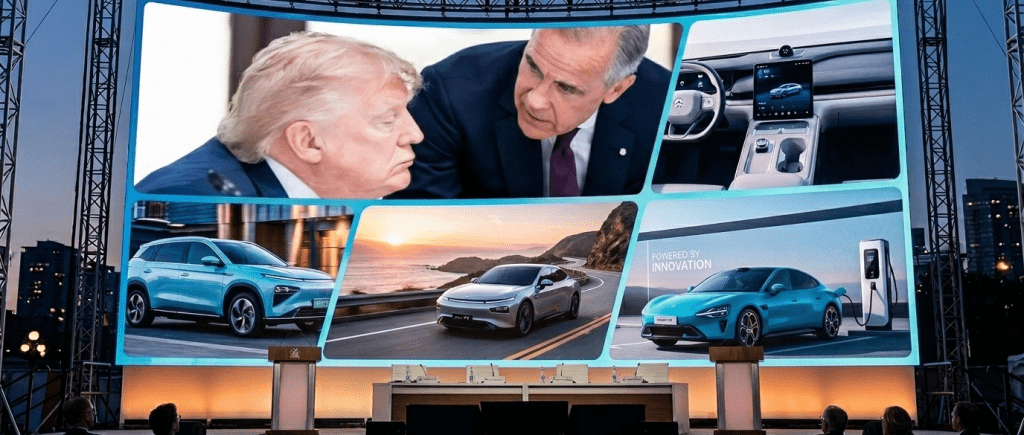
A seemingly casual exchange between the Canadian prime minister and U.S. President Donald Trump has become one of the most talked-about moments of the G7 summit in France, offering a rare glimpse into the delicate trade calculations shaping North America’s economic future.
The conversation, inadvertently captured by a nearby microphone during a working lunch, focused on Canada’s decision to grant limited market access to Chinese electric vehicles under a special tariff arrangement. While brief in duration, the exchange underscored the balancing act facing governments as they attempt to protect domestic industries while maintaining flexibility in an increasingly competitive global economy.
A Small Opening in a Protected Market
At the heart of the discussion was Canada’s decision to create a narrow exception to its broader restrictions on Chinese electric vehicle imports. Although the country maintains significant trade barriers on most Chinese-made EVs, the new policy allows a capped number of vehicles to enter the market each year under a reduced tariff structure.
Canadian officials have argued that the measure is carefully designed to remain limited in scope, representing only a small share of the country’s overall auto market. The objective, they say, is to preserve competition and consumer choice without undermining domestic manufacturers.
According to participants familiar with the exchange, the Canadian prime minister emphasized the strict limits attached to the program, describing it as a tightly controlled initiative rather than a broad shift in trade policy. Trump appeared receptive to the explanation, suggesting that the restricted nature of the arrangement eased potential concerns.
Industry Concerns Persist
Despite the relatively modest scale of the policy, it has generated debate among automakers and industry groups across North America.
Critics argue that even limited access for Chinese manufacturers could create new competitive pressures for domestic producers already navigating a rapidly changing electric vehicle market. Others have raised concerns about the broader implications of opening the door, even slightly, to imports from one of the world’s most dominant EV-producing nations.
Supporters counter that the policy remains highly controlled and does not fundamentally alter Canada’s commitment to supporting its own automotive sector. They view the move as a pragmatic adjustment rather than a strategic realignment.
Trade Diplomacy Beyond Automobiles
The timing of the arrangement has attracted additional attention because it coincides with improving trade conditions between Canada and China in other sectors. Recent developments have eased pressure on certain Canadian exports, creating what many observers see as a broader effort to stabilize economic relations between the two countries.
That has prompted questions about how Canada can maintain productive ties with China while preserving close economic coordination with the United States and Mexico. The challenge is particularly significant given the deeply integrated nature of North America’s manufacturing and supply chains.
For policymakers, the issue extends beyond electric vehicles. It reflects a larger debate about how middle powers navigate a world increasingly shaped by economic competition, strategic rivalries, and shifting trade alliances.
Looking Ahead to Critical Negotiations
The exchange comes as North American leaders prepare for an important new chapter in regional trade discussions. With key review periods for the continent’s trade framework approaching, governments are working to address areas of disagreement before formal negotiations intensify.
While no dedicated bilateral meeting between the two leaders took place during the summit, the unscripted conversation highlighted the importance of ongoing dialogue behind the scenes. Such exchanges often play a crucial role in managing differences before they evolve into larger disputes.
For now, the hot-mic moment has offered an unusually candid glimpse into the practical diplomacy that shapes international trade. What appeared to be a routine conversation about electric vehicles has instead revealed the broader tensions, compromises, and calculations that continue to define economic relations across North America.