Noor Trends News, Technical Analysis, Educational Tools and Recommendations

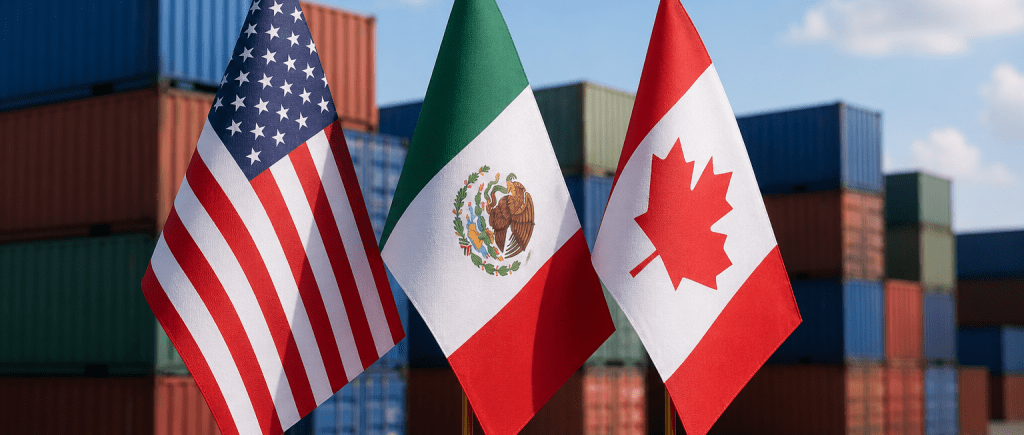
US Refuses Long-Term Renewal of North American Trade Pact, Raising Economic Uncertainty
The United States has declined to approve a long-term renewal of the United States-Mexico-Canada Agreement (USMCA) in its current form, a move that prevents the landmark North American trade pact from automatically extending for another 16 years and opens the door to prolonged negotiations over its future.
The decision leaves the agreement in force for now but introduces fresh uncertainty for businesses and investors across North America, where the deal supports roughly $2 trillion in annual trade.
Washington Seeks Changes Before Extension
A senior US official said the administration chose not to approve an automatic renewal without first addressing unresolved trade issues, stressing that Washington wants substantial revisions before committing to a new long-term framework.
Under the agreement’s review mechanism, all three member countries must unanimously support an extension. Without consensus, the pact shifts into a process of annual reviews while beginning a ten-year countdown that could ultimately see it expire as early as 2036.
Had all parties agreed to renew the deal, the agreement would have remained in force until 2042.
Key Trade Disputes Remain Unresolved
US trade officials continue to push for changes in several sensitive areas, including automotive rules of origin, access to Canada’s dairy market and measures aimed at preventing countries outside the region, particularly China, from benefiting indirectly from the agreement.
Washington argues that these issues must be resolved to strengthen North American manufacturing and protect regional supply chains.
Business Community Warns of Growing Uncertainty
The shift has raised concerns among companies that depend on stable cross-border trade.
Many business organizations argue that long-term certainty is essential for industries such as manufacturing, agriculture and automotive production, where investment decisions often span many years.
However, several US industrial organizations welcomed the administration’s approach, saying annual reviews would give American negotiators greater leverage to secure changes they believe better protect domestic producers.
A Cornerstone of North American Trade
The USMCA entered into force in 2020, replacing the North American Free Trade Agreement (NAFTA), which had governed regional commerce since 1994.
The updated agreement introduced new rules covering digital trade, labor standards and regional manufacturing requirements, including stricter rules requiring a larger share of vehicle components to be produced within North America.
With automatic renewal now off the table, negotiations among the United States, Canada and Mexico are expected to become an annual feature over the coming years, leaving the future of one of the world’s largest free trade blocs increasingly uncertain.