Noor Trends News, Technical Analysis, Educational Tools and Recommendations

Key Takeaways
- ECB raises rates: The deposit rate was lifted to 2.25% from 2% — the first increase in almost three years — in line with expectations.
- Iran war the trigger: A spike in energy prices driven by the Middle East conflict is the primary force behind the policy shift.
- Eurozone inflation above target: Price growth now stands above 3%, topping the ECB’s 2% objective.
- “Robust across scenarios”: The ECB said the hike is justified across a range of possible outcomes for how the conflict may evolve.
- Inflation forecasts raised: The ECB now sees headline inflation at 3.0% in 2026, 2.3% in 2027, and 2.0% in 2028 — up from prior forecasts of 2.6%, 2.0%, and 2.1%.
- Growth forecasts cut: Eurozone GDP is now expected at 0.8% this year, down from the prior 0.9% projection.
- Stagflation risk grows: Higher rates arriving alongside slowing growth and surging energy costs present a difficult policy dilemma.
- September hike fully priced: Markets are already betting on a follow-up move; Lagarde’s press conference tone will be closely parsed.
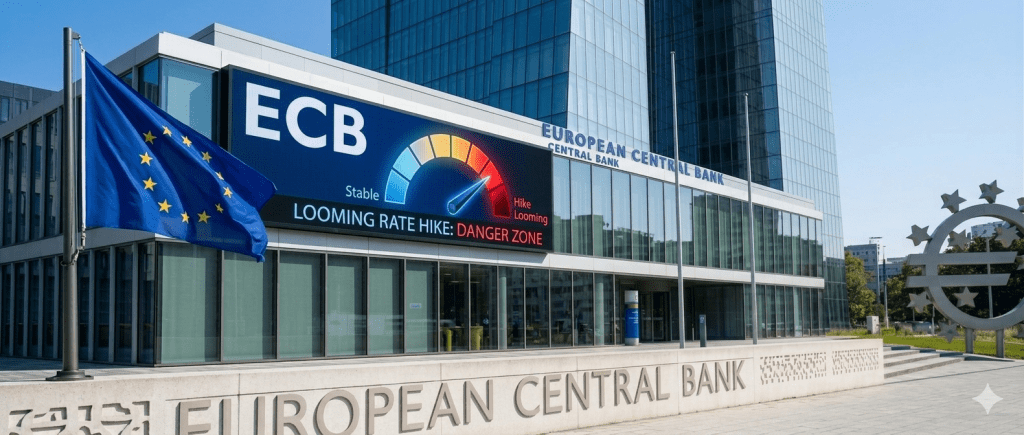
The European Central Bank has lifted its main deposit rate to 2.25% from 2%, in line with expectations, as policymakers aim to keep a lid on upward inflationary pressures being fueled by a spike in energy prices due to the Iran war.
Bets have grown that central banks will need to take a more hawkish policy stance in response to the oil shock. In the Eurozone currency area, the rate of price growth now stands above 3% — topping the ECB’s 2% target.
In a statement, the ECB said the decision to raise rates for the first time in almost three years is “robust across a range of scenarios mapping out how the shock might evolve and affect the medium-term outlook” for the 21-member Eurozone. The hike puts the ECB in a position to navigate uncertainty caused by the now more than three-month-old conflict in the Middle East, officials argued.
New Eurosystem staff projections now predict that headline inflation will average 3% this year, 2.3% in 2027, and 2% in 2028. Previously, the ECB had seen the figures at 2.6%, 2%, and 2.1%, respectively.
Eurozone growth forecasts, meanwhile, were slashed. Gross domestic product in the region is now seen at 0.8% this year, compared to prior predictions of 0.9%.