 Noor Trends News, Technical Analysis, Educational Tools and Recommendations

Key Takeaways
- Gold at 11-week low: Spot gold fell 0.8% to $4,296.08 per ounce — its weakest level since March 23; gold futures dropped 1% to $4,322.60.
- Friday’s 3% slump extended: The yellow metal suffered its worst single-day decline in months on Friday’s payrolls shock.
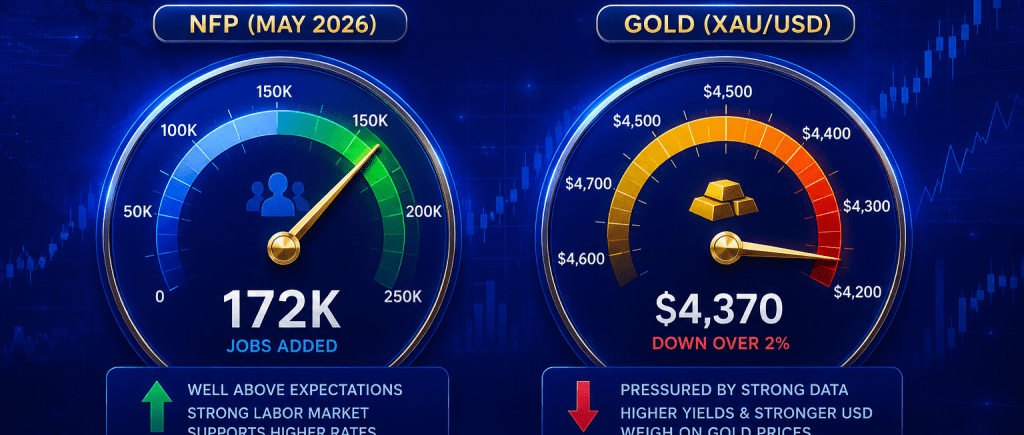
- Jobs data crushes rate cut hopes: The U.S. added 172,000 jobs in May — well above forecasts — while unemployment held steady at 4.3%.
- December rate hike now fully priced: “We now have a rate hike fully priced at the December FOMC meeting,” ING analysts said.
- Treasury yields and dollar surge: Both rose sharply on Friday; the DXY held near a two-month high Monday.
- Israel strikes Iranian energy infrastructure: Israel targeted military sites in western and central Iran and hit a petrochemical facility near Mahshahr — the most significant attack on Iranian energy-linked infrastructure since the April ceasefire.
- Iran’s retaliation: Tehran launched multiple missile barrages at Israel in response to an Israeli strike on Beirut’s outskirts.
- Oil surges nearly 5%: Crude’s rally amplifies global inflation concerns, further squeezing gold’s appeal.
- Safe-haven paradox: Geopolitical tensions would typically lift gold, but the firm dollar and rate hike fears are overpowering that effect.
- Silver falls 1.2%: To $677.00 per ounce.
- Platinum slips 0.9%: To $1,764.58 per ounce.
- Copper mixed: LME copper edged up 0.3% to $13,543.33 per ton; U.S. copper futures fell 0.1%.
Gold prices extended losses on Monday, hitting their lowest in 11 weeks, as robust U.S. jobs data reinforced expectations of higher-for-longer Federal Reserve interest rates, while a rebound in oil prices amid renewed Gulf hostilities fueled inflation concerns.
Spot gold was last down 0.8% at $4,296.08 an ounce by 02:49 ET (06:49 GMT) — reaching its lowest since March 23.
U.S. gold futures for August delivery slipped 1% to $4,322.60 per ounce.
The precious metal slipped more than 3% on Friday as investors reassessed the outlook for U.S. monetary policy following stronger-than-expected labor market data.
Strong U.S. Jobs Data Reinforces Fed Hike Bets
Data released on Friday showed the U.S. economy added 172,000 jobs in May — well above economists’ forecasts — while the unemployment rate held steady at 4.3%.
The report prompted traders to scale back expectations for a Federal Reserve rate cut this year, pushing Treasury yields and the U.S. dollar higher and reducing the appeal of non-yielding assets such as gold.
“Despite the lack of consistent messaging in the labour market data, we now have a rate hike fully priced at the December FOMC meeting,” ING analysts said in a recent note.
The U.S. Dollar Index traded largely flat in Asian trading on Monday after surging to a two-month high in the previous session.
Israel-Iran Tensions Escalate; Oil Surges
Israel on Monday said it had targeted military sites in western and central Iran, as well as a petrochemical facility near Mahshahr — marking a significant attack on Iranian energy-linked infrastructure since a ceasefire was reached in April.
The move came after Iran launched several rounds of missiles toward Israel in response to an Israeli strike on the outskirts of Beirut.
Oil prices surged nearly 5% on Monday, adding to concerns that higher energy costs could complicate the global inflation outlook.
While gold traditionally benefits from safe-haven demand during periods of geopolitical uncertainty, the metal was pressured by a firmer dollar amid growing Fed rate hike expectations.
Among other precious metals, silver prices fell 1.2% to $677.00 per ounce, while platinum slipped 0.9% to $1,764.58 per ounce.
Benchmark copper futures on the London Metal Exchange edged up 0.3% to $13,543.33 a ton, while U.S. copper futures fell 0.1% to $6.28 a pound.