Noor Trends News, Technical Analysis, Educational Tools and Recommendations

Precious metals are trading cautiously as investors wrestle with a complex and often contradictory set of signals. On one side, persistent geopolitical tensions and long-term structural demand continue to underpin both gold and silver. On the other, stubborn inflation pressures and the prospect of higher interest rates for longer are limiting the appetite for non-yielding assets. The result is a market in careful balance — neither surging nor collapsing, but watching and waiting.
Gold Stabilizes Around $4,470 After a Turbulent Run
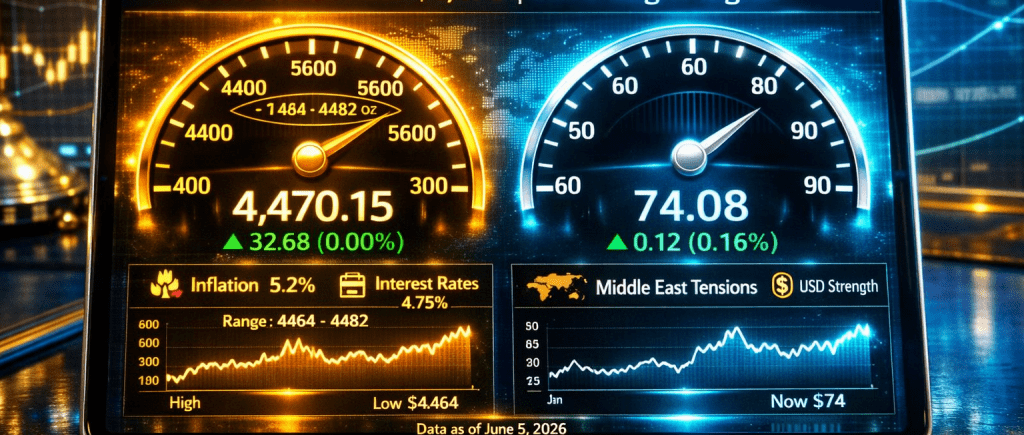
Gold is trading near $4,470 per ounce, virtually unchanged on the day, after oscillating in a tight range between $4,464 and $4,482. The modest movement belies a dramatic year for the metal, which has gained more than 32% over the past twelve months and reached a record high above $5,600 per ounce earlier this year before pulling back sharply.
That pullback — roughly 16% from the January peak — has been driven primarily by the conflict in the Middle East, which triggered a surge in oil prices and reignited fears of persistent inflation. Higher energy costs raise the prospect of central banks keeping interest rates elevated, which weighs on gold by increasing the opportunity cost of holding an asset that pays no income.
Despite this pressure, gold has not collapsed. Ongoing geopolitical uncertainty continues to attract investors seeking a reliable store of value, and central banks around the world have sustained their gold-buying programs, providing a structural floor beneath prices. The combination of these forces has left gold in a consolidation phase — supported from below, but capped from above.
Silver Inches Up but Struggles to Find Direction
Silver is faring only slightly better, trading at around $74 per ounce with a gain of just 0.16% on the session. The day’s range has been equally narrow, between $73.81 and $74.13, reflecting the same uncertainty that has gripped the broader precious metals market.
Silver’s year has been extraordinary by historical standards. The metal reached an all-time high above $121 per ounce earlier in 2026 before retreating dramatically, and it now trades at a fraction of that peak. The sell-off was driven by the same inflation and interest rate concerns weighing on gold, compounded by the reversal of speculative positioning that had built up during silver’s parabolic rise.
What distinguishes silver from gold is its sensitivity to industrial activity. Silver is a critical input in electronics, renewable energy technology, and manufacturing, meaning its price tends to reflect the health of the global economy as much as investor sentiment. This dual nature can amplify both gains and losses, and at present, the uncertain growth outlook is keeping a lid on silver’s recovery.
The Common Thread: Inflation, Interest Rates, and the Middle East
Both metals are being shaped by the same trio of forces. The first is the ongoing conflict in the Middle East, which has kept oil prices elevated and fueled inflation expectations in major economies. The second is the monetary policy response to that inflation, with central banks signaling a willingness to maintain or even raise interest rates — a headwind for assets that offer no yield. The third is the U.S. dollar, which has remained relatively firm amid geopolitical uncertainty, making dollar-priced commodities more expensive for international buyers.
There are, however, reasons for cautious optimism. Any diplomatic progress toward a ceasefire or resolution in the Middle East would likely cause oil prices to ease, easing inflation fears and reducing pressure on interest rate expectations. In that scenario, both gold and silver would stand to benefit meaningfully.
A Market Waiting for a Catalyst
For now, precious metals appear to be in a holding pattern. The long-term case for both gold and silver remains intact — structural demand, a decade-long trend of central bank accumulation, and the enduring role of hard assets as hedges against uncertainty all point to continued relevance. But the short-term path forward depends on developments that remain unresolved.
Until inflation shows clear signs of easing, or until geopolitical tensions begin to de-escalate, gold and silver are likely to remain range-bound — closely watched, carefully held, and waiting for the signal that brings clarity back to the market.