Noor Trends News, Technical Analysis, Educational Tools and Recommendations

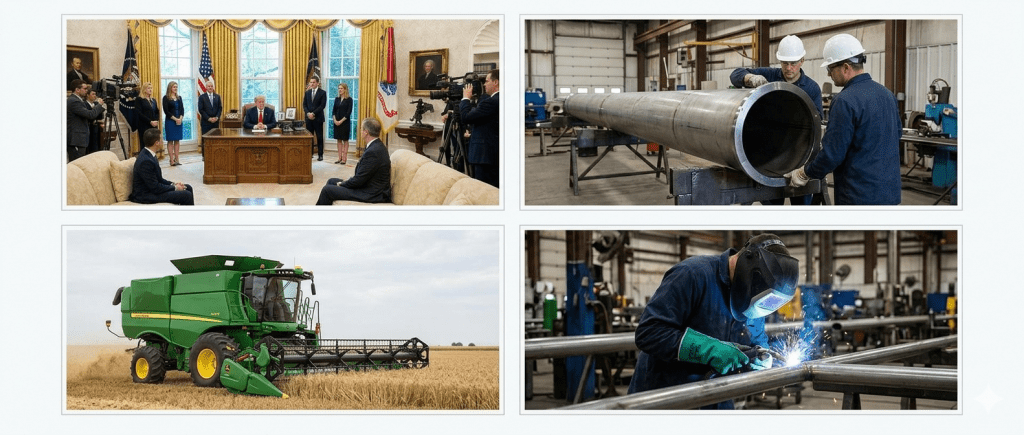
Trump Eases Metal Tariffs to Boost US Manufacturing
In a significant shift to his trade agenda, President Donald Trump signed a presidential proclamation on June 1, 2026, adjusting tariffs on imported steel, aluminum, and copper. The White House framed the move as a critical step toward rebuilding America’s industrial base, but the timing — just months before midterm elections — has raised questions about who the policy is really designed to help.
**A Targeted Cut, Not a Full Retreat**
The new order lowers tariffs on certain imported industrial and agricultural equipment from 25% to 15%, covering machinery like combines, harvesters, bulldozers, and forklifts, as well as heating and air conditioning systems. The reductions are explicitly temporary, set to expire at the end of 2027, giving manufacturers a narrow window to ramp up domestic investment.
There is also a meaningful incentive built into the policy for foreign manufacturers: companies that build their equipment using at least 85% American-produced steel, aluminum, or copper will qualify for an even lower tariff rate of just 10%. The message from Washington is clear — use American metal, and the door opens wider.
**The Protective Wall Stays Standing**
What the proclamation does not touch is equally important. A steep 50% tariff remains firmly in place on raw imports of steel, aluminum, and copper, applied to the full value of the product rather than just its metal content. American metal producers remain heavily shielded from foreign competition, while equipment manufacturers downstream receive only a modest degree of relief.
The United States became the world’s third-largest steel producer in 2025, a milestone the White House attributes directly to its tariff strategy. New steel plants are being built across the country for the first time in a generation, and investment is flowing into aluminum smelting and copper mining operations at a pace not seen in decades.
Investment Pouring In
The policy appears to be delivering results on the investment front. A major new aluminum smelter is being built in Oklahoma — the first such project in the United States in many years — backed by a joint venture between American and Gulf-based energy companies. Copper mining and fabrication operations are also expanding significantly across multiple states.
In May 2026, American manufacturing grew at its fastest rate in four years, marking five consecutive months of expansion and far exceeding expectations. The White House points to these figures as evidence that its America First trade strategy is working.
**Farmers Caught in the Crossfire**
Behind the strong manufacturing numbers lies a more complicated story for America’s agricultural sector. Farmers who need to purchase imported combines, harvesters, and other heavy machinery have been quietly absorbing the cost of the tariff regime for months. Because these machines are built largely from steel and aluminum, the protective tariffs that benefit metal producers have simultaneously driven up equipment prices for the very farmers who depend on that machinery to work their land.
The tariff cut on agricultural equipment to 15% is effectively an acknowledgment of that unintended burden. Surveys of farmer sentiment conducted in May showed confidence falling sharply, with capital investment in farm equipment dropping to its lowest level in nearly two years. Many farmers have been delaying major purchases, uncertain whether the economics of buying new machinery make sense under current conditions.
Equipment dealers and manufacturers have also flagged rising costs, labor shortages, and policy uncertainty as factors pushing machinery prices higher, with many in the industry expecting costs to keep climbing through the end of the year.
**The Bigger Picture**
The proclamation lands at a politically sensitive moment, with midterm elections approaching and agricultural states representing significant electoral weight. Whether this adjustment will be enough to restore confidence among American farmers and manufacturers remains to be seen. What is clear is that Trump’s trade strategy continues to evolve — using tariffs not as a blunt instrument, but as a lever to be raised and lowered depending on which industries need protection and which need relief at any given moment.