Noor Trends News, Technical Analysis, Educational Tools and Recommendations

A powerful surge in artificial intelligence spending is reshaping the semiconductor landscape—and one of the biggest winners isn’t the flashiest name in chips. Texas Instruments has just delivered a standout moment on Wall Street, with its stock jumping sharply after a strong earnings report and an optimistic outlook tied directly to the AI boom.
A Breakout Moment Fueled by Strong Results
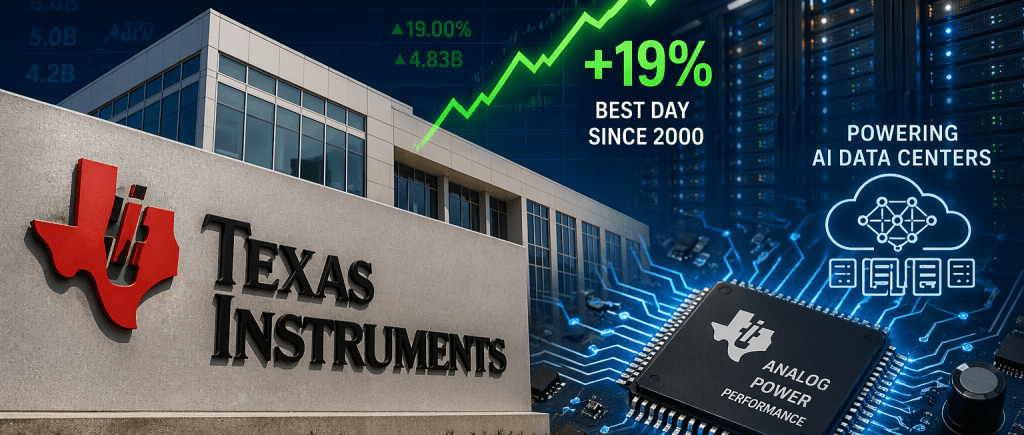
The company posted a robust first quarter, beating expectations on both revenue and profit. Sales climbed to roughly $4.8 billion, reflecting solid growth compared to the same period last year, while earnings also came in well above forecasts.
Investors reacted quickly. The stock surged nearly 20% in a single session—its strongest performance since the dot-com era—highlighting renewed confidence in the company’s role in the next phase of tech growth.
The Quiet Power Behind AI Infrastructure
While headlines often focus on high-performance processors from companies like Nvidia or Advanced Micro Devices, Texas Instruments operates in a different but equally critical space.
Its specialty is analog chips—the components that manage power, process real-world signals, and ensure that complex digital systems function reliably. These chips don’t grab attention, but without them, modern data centers simply wouldn’t work.
As AI systems expand, so does the need for these foundational technologies.
Data Centers Are Driving Explosive Demand
The rapid buildout of AI data centers is a major growth engine. Tech giants like Meta Platforms and Amazon are investing heavily in infrastructure to support AI workloads, creating ripple effects across the entire semiconductor supply chain.
That demand is already visible in the numbers. Revenue tied to data centers surged dramatically compared to last year, while industrial-related sales also posted strong gains.
Confidence in Continued Growth
Looking ahead, the company expects momentum to continue. It forecasts another quarter of solid growth, with revenue potentially exceeding $5 billion and profits rising further.
Management signaled readiness to keep up with demand—even if growth accelerates beyond current levels—suggesting confidence not just in short-term performance, but in the durability of the AI-driven cycle.
A Broad Customer Base Strengthens Its Position
Unlike some chipmakers that rely heavily on a narrow set of clients, Texas Instruments benefits from a wide customer base. Its chips are used across industries—from consumer electronics to automotive and aerospace.
Major customers include companies like Apple, as well as players in automotive, healthcare, and even space technology. This diversification helps stabilize revenue while still allowing the company to capitalize on fast-growing sectors like AI.
Massive Investment to Secure the Future
To meet rising demand, the company is investing heavily in manufacturing. It has committed tens of billions of dollars to expand production capacity, particularly in the United States, while maintaining a global footprint across Europe and Asia.
It is also strengthening its capabilities through acquisitions, especially in wireless connectivity and industrial chip design—areas expected to grow alongside automation and smart devices.
The Bigger Picture: AI’s Expanding Ecosystem
The recent surge in Texas Instruments’ stock is a reminder that the AI revolution extends far beyond cutting-edge processors. It depends on an entire ecosystem of technologies working together—from data centers and cloud infrastructure to the analog components that quietly keep everything running. In that ecosystem, Texas Instruments is proving to be one of the most important—and increasingly valuable—players.