Noor Trends News, Technical Analysis, Educational Tools and Recommendations

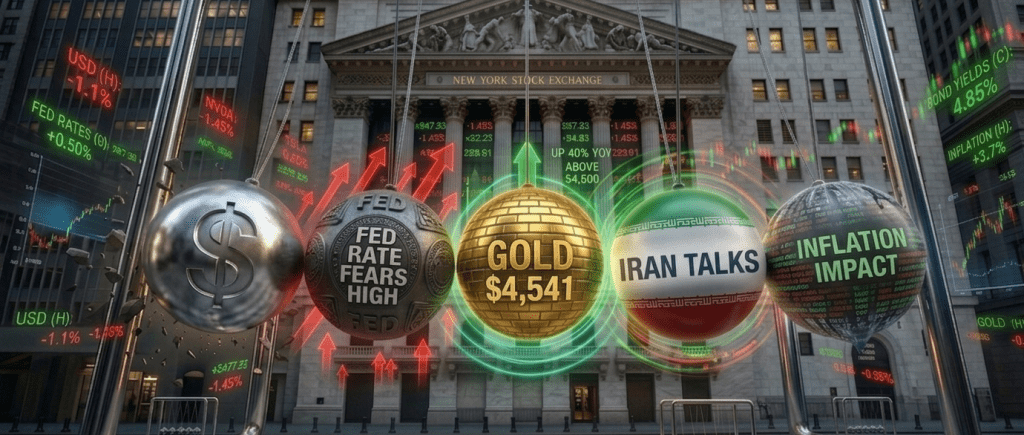
Gold prices moved lower on Thursday as investors struggled to balance rising geopolitical uncertainty against growing expectations that US interest rates could remain elevated for longer.
The precious metal slipped back toward the $4,500 level after failing to sustain the previous session’s rebound, with markets increasingly focused on the complicated state of negotiations between Washington and Tehran.
Fresh reports suggesting disagreements over Iran’s uranium program weakened hopes for a near-term diplomatic breakthrough, reviving concerns that tensions in the Middle East could remain unresolved for longer than investors had anticipated.
Although conflicting statements later emerged regarding the status of negotiations, the broader message from markets was clear: optimism surrounding a rapid peace agreement has faded significantly.
Oil-Driven Inflation Fears Strengthen the Dollar and Pressure Gold
The uncertainty surrounding the conflict continues to support oil prices, reinforcing fears that energy-driven inflation could remain a major global problem in the months ahead.
That dynamic is becoming increasingly important for financial markets because higher energy prices directly complicate the Federal Reserve’s fight against inflation. Investors are now growing more convinced that US policymakers may be forced to maintain restrictive monetary policy for longer, and some traders are even beginning to price in the possibility of another rate hike before the end of the year.
This shift has helped keep Treasury yields elevated while supporting the US Dollar, both of which tend to weigh heavily on non-yielding assets such as gold.
Federal Reserve Maintains a Hawkish Tone
The latest Federal Reserve meeting minutes reinforced the market’s higher-for-longer narrative, with officials expressing concern that inflation risks remain tilted to the upside due to geopolitical tensions, energy prices, and broader economic uncertainty.
Policymakers signaled that interest rates may need to remain restrictive for an extended period if inflation fails to move convincingly back toward target levels.
That message has reduced appetite for aggressive bullish positioning in gold despite ongoing geopolitical instability.
Gold Caught Between Safe-Haven Demand and Rate Pressure
Gold is currently trapped between two opposing macro forces. On one side, geopolitical tensions and fears of escalation in the Middle East continue to support safe-haven demand. On the other, rising bond yields and a stronger dollar are limiting the metal’s upside potential by increasing the opportunity cost of holding bullion.
As a result, gold remains highly sensitive to every new headline surrounding US-Iran negotiations, oil prices, and Federal Reserve policy expectations.
Investors Turn Attention Toward US Economic Data
Markets are also closely monitoring incoming US economic data for clues about the broader health of the economy and the likely direction of monetary policy.
Recent figures showed the US labor market remains relatively resilient, while business activity indicators pointed to steady economic expansion. The combination of stable growth and persistent inflation continues reinforcing the argument for prolonged restrictive policy.
For investors, this creates a difficult environment where slowing geopolitical fears can quickly pressure gold lower, while any renewed escalation could rapidly restore demand for defensive assets.
Market Mood Remains Fragile
The broader market atmosphere remains cautious rather than outright risk-on. Investors are attempting to navigate a world where geopolitical uncertainty, energy inflation, and central bank policy are becoming increasingly interconnected.
For now, gold remains under pressure as traders weigh fading optimism over a US-Iran agreement against the growing reality that elevated inflation and high interest rates may remain dominant themes across global markets well into the second half of the year.