Noor Trends News, Technical Analysis, Educational Tools and Recommendations

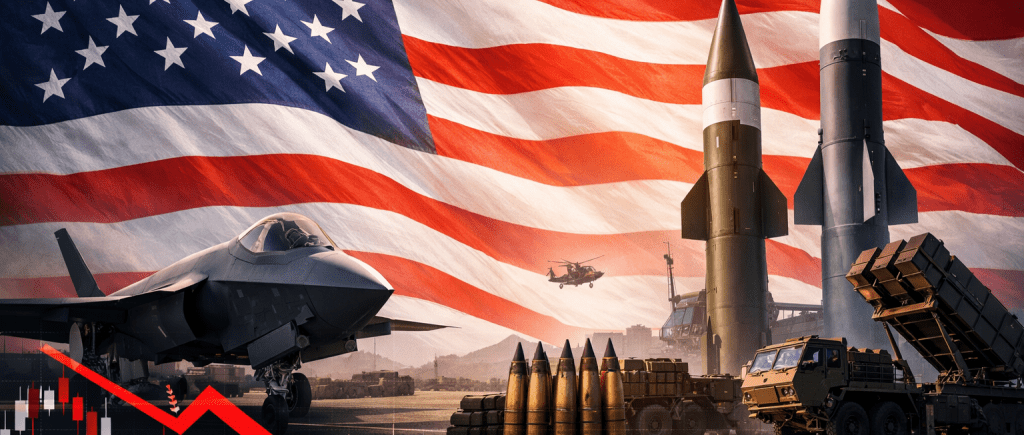
Defense stocks are facing a rough week, with investor confidence shaken in their role as safe havens. Lockheed Martin’s disappointing earnings report has amplified concerns and sent shockwaves across the sector.
Earnings Under Pressure
Lockheed Martin’s first-quarter results revealed a sharp setback. Revenue held steady at $18.0 billion compared to last year, but net earnings fell to $1.49 billion, or $6.44 per share, down from $1.71 billion ($7.28 per share) in the same quarter of 2025. Cash flow was particularly troubling, with operations generating only $220 million versus $1.4 billion a year earlier. Free cash flow swung into negative territory at –$291 million, compared to a healthy +$955 million last year. Segment performance highlighted the strain: aeronautics profits dropped 14% due to F-16 delays and C-130 delivery issues, rotary and mission systems fell 19%, and space declined 26%. The only bright spot was missiles and fire control, which rose 8% thanks to strong demand for Patriot and tactical missile systems.
Strategic Moves Amid Challenges
Despite these challenges, Lockheed emphasized its long-term resilience. The company signed multi-year agreements with the U.S. government to accelerate production of advanced missile systems, aiming to triple or quadruple output. It also celebrated the success of its Orion spacecraft in NASA’s Artemis II mission, reinforcing its leadership in space exploration. Management reaffirmed its 2026 guidance, projecting free cash flow between $6.5–$6.8 billion later in the year, supported by expanding missile production and stable government contracts.
Sector-Wide Turbulence
The turbulence is not limited to Lockheed. Honeywell, despite beating earnings expectations, saw its stock slide nearly 2.5%, reflecting broader investor unease. Across the sector, defense equities have lost momentum, with U.S. stocks falling nearly 8% in March despite ongoing geopolitical conflicts. Analysts note that the traditional “buy-on-conflict” trade has weakened, as investors weigh rising costs, supply chain constraints, and high valuations against long-term demand. European defense firms such as Safran and Saab reported strong revenue growth, but declining orders tempered enthusiasm, underscoring the sector’s mixed outlook.
Investor Confidence Under Fire
The takeaway is clear: defense stocks are no longer guaranteed safe havens. Earnings misses, cautious guidance, and shifting geopolitical priorities are reshaping investor expectations. While missile demand and space programs provide long-term stability, near-term volatility is likely to persist. For investors, the sector now represents both opportunity and risk, demanding sharper scrutiny than in the past.
Lockheed Martin