 Noor Trends News, Technical Analysis, Educational Tools and Recommendations

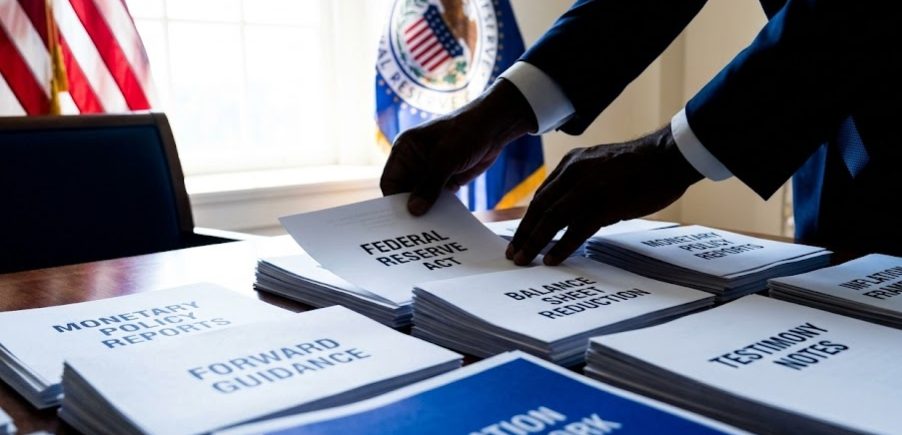
Kevin Warsh, President Donald Trump’s nominee to succeed Jerome Powell at the helm of the Federal Reserve, appeared before the Senate Banking Committee on Tuesday in a confirmation hearing that observers described as one of the most consequential in the central bank’s recent history. His testimony was rich with bold monetary positions — he did not present himself merely as a replacement for Powell, but as an agent of sweeping institutional reform, a man who views the Fed as an institution that has erred, stumbled, and drifted far from its proper course.
“Inflation Is a Choice” — A Clean Break With Decades of Central Bank Orthodoxy
Warsh opened his testimony with a philosophical declaration rarely heard from a central banking official: “Inflation is a choice.” The statement carries within it an implicit acknowledgment that the waves of price surges Americans have endured in recent years were not inevitable acts of economic fate, but the product of policy decisions — wrong ones made, or right ones not made in time. He went further, noting that Congress entrusted the Fed with the mission of achieving price stability “without excuse or equivocation, argument or anguish,” in a pointed reference to what he called “the legacy of the Fed’s policy errors” — a burden the institution now carries and must confront directly.
By Warsh’s own measure, true price stability is achieved when nobody is talking about inflation at all. It is an ambitious standard that sets the bar of expectations far above the current reality, where the annual inflation index currently exceeds 3.3% — the highest reading in nearly two years, driven in no small part by the surge in energy costs stemming from the ongoing conflict with Iran.
“Regime Change” — A Blueprint for Comprehensive Reform
Warsh moved well beyond passing criticism in his testimony, calling for what he described as “a regime change in the conduct of monetary policy,” insisting on a new inflation framework, new tools in the policy toolkit, and a fundamentally different communications strategy — one that departs sharply from what investors and markets have grown accustomed to over years. On the question of tools, he expressed a clear preference for the interest rate instrument as the most fair and effective lever available, standing in contrast to the excessive reliance on balance sheet expansion that defined the quantitative easing era.
As for the balance sheet itself — which currently stands at approximately $6.71 trillion — Warsh argued that reducing it would help contain inflation and open space for further rate cuts down the line, though he indicated that any such reduction must proceed carefully and be grounded in deeper structural reform.
On communications, Warsh delivered perhaps his most striking statement of the day: “I don’t believe in forward guidance.” It was a direct repudiation of the “dot plot” system that requires members of the Federal Open Market Committee to publish their anonymous quarterly forecasts for the rate path. Warsh argued that these projections generate confusion rather than clarity, constrain the decision-maker rather than build credibility, and that the economic landscape is evolving far too quickly for quarterly forecasts to keep pace. “The supply side of the economy is changing dramatically,” he said, and the Fed’s communications architecture must change with it.
Independence That Is Earned, Not Granted
In one of the hearing’s most telling moments, Warsh insisted that the Federal Reserve’s independence is not a right conferred by statute alone — it is “critically important but must be earned,” and it is earned by “delivering on promises.” He noted that the Fed had “wandered outside its remit in recent years,” and made clear he had no intention of continuing in that direction. He also stressed the importance of central bankers being willing to change their minds when the data demands it, and of correcting mistakes “fast” when they are made — an implicit criticism of the institutional culture of defending past decisions that has long characterized many central banking establishments worldwide.
The Monetary Outlook: Between the Desire to Cut and the Obstacle of Inflation
Warsh’s testimony cannot be read in isolation from the complex economic environment surrounding it. Since his nomination was announced in January, market expectations have shifted dramatically. At the time, markets were pricing in three 25-basis-point cuts through 2026. Rate probability tracking tools now show roughly 60% of traders expecting rates to remain unchanged at 3.5%–3.75% through year-end — a stark reversal that reflects the inflationary impact of escalating Middle East tensions and surging crude oil prices in the wake of the Iran conflict.
Warsh built his reputation during his time as a Fed governor between 2006 and 2011 as a committed inflation hawk, one who advocated for raising rates even in the aftermath of the global financial crisis out of concern that inflation was waiting in the wings. More recently, however, he has signaled openness to lower rates, suggesting that productivity gains driven by artificial intelligence could serve as a disinflationary force capable of absorbing looser monetary conditions. He wrote in a Wall Street Journal op-ed last November that “AI will be a significant disinflationary force.” This shift in posture has not gone unnoticed, and it has raised serious questions about the consistency between his past hawkishness and his current rhetoric about rigorous inflation discipline.
Adding further complexity, even if Warsh genuinely desired rate cuts, he would not be able to deliver them by will alone. Interest rates are set by majority vote among the twelve members of the Federal Open Market Committee, many of whom remain reluctant to ease policy until inflation is meaningfully closer to the 2% target — a more challenging goal in an environment of elevated energy prices and supply chain disruptions tied to regional conflict.
The Shadow of War Over the Hearing Room
The hearing did not take place in a vacuum. The American-Israeli military campaign against Iran cast a long shadow over the proceedings. The President declared on Monday that an extension of the ceasefire with Iran — due to expire Wednesday — was “highly unlikely.” Iran’s chief negotiator meanwhile stated that Tehran would not accept talks “under the shadow of threats,” and hinted that the country was preparing to “reveal new cards on the battlefield.”
The markets responded immediately: Brent crude and WTI each climbed more than 2% to $97.95 and $89.78 per barrel respectively. The Dow Jones erased gains of more than 400 points that had accumulated earlier in the session, while the S&P 500 and Nasdaq each fell approximately 0.2%. The ten-year Treasury yield climbed to 4.3%, as investors attempted to decode the implications of Warsh’s call for a “new inflation framework” against a backdrop of rising geopolitical risk.
Warsh left today’s hearing having painted a clear picture of what he wants from the Federal Reserve: a sharper interest rate instrument, a smaller balance sheet, far less communication, and far greater accountability. But the distance between vision and execution is long and complicated inside a central bank that makes its decisions by collective vote, operating in a turbulent economic environment, under geopolitical pressure of an unprecedented scale.
Whether he is ultimately seen as a genuine reformer or as someone sufficiently flexible to accommodate executive branch pressure, his confirmation — if it comes — will in all likelihood open an entirely new chapter in the history of the Federal Reserve.