Noor Trends News, Technical Analysis, Educational Tools and Recommendations

In a long-awaited return to Beijing after years of strained relations, US President Donald Trump arrived in the capital of China on Wednesday for his first visit to China since 2017, marking a major diplomatic moment set against a backdrop of deep economic rivalry and political mistrust between the world’s two largest economies.
Trump is leading an unusually large delegation that includes top economic officials and several of America’s most influential business leaders. Among them are high-profile figures from the global technology sector, signaling that artificial intelligence, semiconductors, and digital infrastructure will dominate the agenda alongside traditional trade issues.
The visit spans two days and includes scheduled high-level meetings with Chinese President Xi Jinping on Thursday and Friday. Both sides enter the talks under pressure to stabilize relations while still defending sharply diverging strategic and economic interests.
Fragile Trade Truce Built on Limited Concessions
The summit is taking place against a long history of escalating economic friction. Over the past several years, trade between the two countries has fallen significantly compared to its peak, reflecting years of tariffs, countermeasures, and policy restrictions.
A partial trade truce reached last year temporarily eased tensions. Under that agreement, China increased purchases of key American agricultural products, including soybeans, while the United States eased some tariff measures. The arrangement helped slow the downward spiral in bilateral trade, but it did not resolve underlying structural disputes.
Despite this temporary calm, tensions have continued to simmer, particularly in sectors tied to advanced technology and critical supply chains. Both governments remain locked in competition over industrial dominance, especially in areas that define future economic power.
Technology and Semiconductor Restrictions at the Center of Dispute
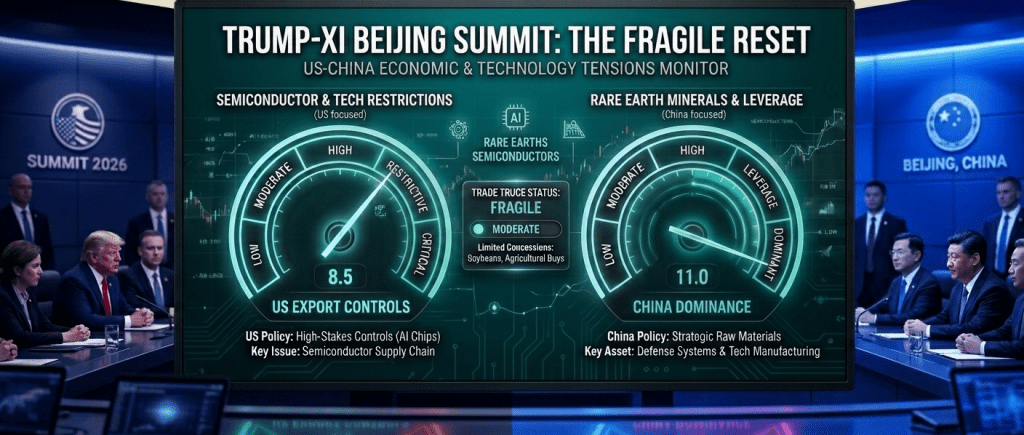
One of the most sensitive issues on the agenda is the global semiconductor supply chain, particularly advanced artificial intelligence chips. The United States has maintained strict export controls on high-end chips, citing national security concerns and the risk of military applications.
These restrictions have become a major point of contention. Leading technology firms argue that limiting access to advanced chips could accelerate China’s efforts to build a fully independent semiconductor ecosystem, potentially weakening long-term US influence in the sector.
China, meanwhile, is pressing for broader access to advanced computing technology, viewing it as essential for its industrial modernization and competitiveness in artificial intelligence. At the same time, Washington is seeking assurances regarding China’s control over critical materials that feed into chip production and high-tech manufacturing.
Rare Earth Materials: China’s Strategic Leverage
Beyond semiconductors, rare earth elements have emerged as one of the most powerful bargaining tools in the global economic rivalry.
China dominates the production and processing of rare earth minerals, which are essential for advanced electronics, defense systems, electric vehicles, and renewable energy technologies. This dominance has given Beijing significant leverage in negotiations.
During previous periods of heightened tension, signals from Chinese leadership suggesting potential restrictions on rare earth exports triggered major concern in global markets and added pressure on Washington to de-escalate.
As a result, rare earth supply chains are now viewed as a strategic vulnerability for the United States and a key negotiating asset for China. This dynamic is expected to heavily influence discussions during the summit.
Business Heavyweights Signal a Commercially Driven Agenda
The presence of major corporate leaders in Trump’s delegation underscores the economic focus of the visit. Executives from leading technology companies are expected to advocate for more stable access to Chinese markets and clearer regulatory frameworks, particularly in areas involving artificial intelligence hardware and consumer electronics.
Agricultural exports and aerospace deals are also expected to feature prominently, with American negotiators seeking expanded Chinese purchases as part of any renewed trade understanding.
However, despite the commercial optimism, the talks remain constrained by broader geopolitical rivalry, meaning any agreements are likely to be incremental rather than transformative.
Limited Expectations for a Major Breakthrough
Analysts broadly expect the summit to produce modest outcomes rather than sweeping agreements. The most likely result is an extension of the existing trade truce, along with renewed commitments on agricultural purchases and limited easing of specific trade barriers.
Some progress may also be made on narrowly defined technical issues, particularly related to semiconductor exports and supply chain coordination. However, deep structural disputes over technology leadership, industrial policy, and strategic competition are expected to remain unresolved.
Both sides have political incentives to present the meeting as constructive. Trump is likely to emphasize tangible economic wins that can be highlighted domestically, while Xi is expected to focus on stability, sovereignty, and China’s status as a global power on equal footing with the United States.
0
Economic Competition Continues Beneath Diplomatic Engagement
Preliminary discussions between senior economic officials from both countries in recent weeks were described as constructive, suggesting a willingness to maintain dialogue despite ongoing tensions.
Yet beneath the diplomatic language, the broader rivalry continues to intensify across multiple domains, including trade, technology, finance, and strategic resources. Experts warn that while this summit may temporarily stabilize relations, it does not signal a long-term resolution of structural competition.
Instead, it reflects a managed pause in an increasingly complex economic confrontation—one that is likely to shape global markets and geopolitical alignments for years to come.