Noor Trends News, Technical Analysis, Educational Tools and Recommendations

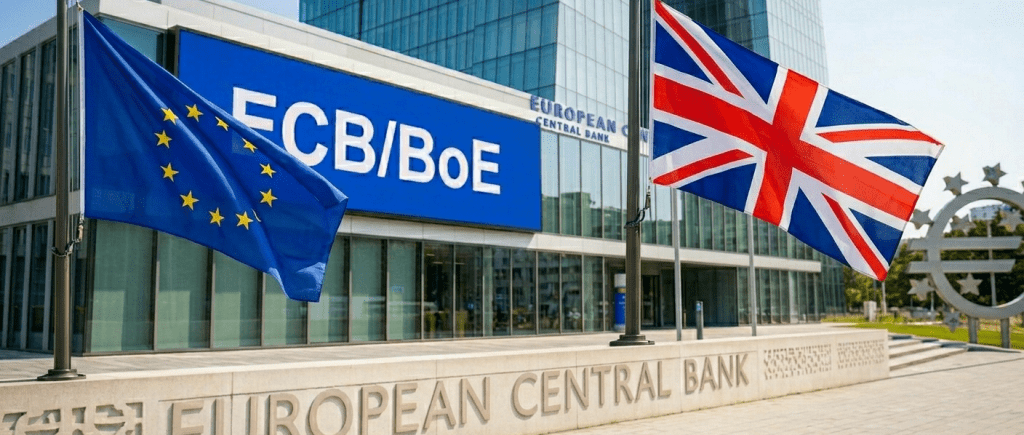
Across global markets, anticipation is building as the European Central Bank and the Bank of England approach their next policy decisions. Yet instead of bold moves, both institutions appear set to stand still—choosing caution over action as uncertainty tightens its grip on the global economy.
A Crisis Choking the Global Artery
At the heart of this hesitation lies the fragile situation around the Strait of Hormuz, one of the world’s most critical energy corridors. Any instability in this narrow passage reverberates instantly across oil and gas markets, amplifying volatility and clouding economic forecasts.
For policymakers, the dilemma is stark. On one side, rising energy prices threaten to reignite inflation, potentially requiring higher interest rates. On the other, tightening financial conditions risk suffocating an already delicate economic recovery. It’s a balancing act with little room for error.
Forecasting in the Fog
Officials have openly acknowledged the unusual difficulty of the current environment. The stop-and-start nature of geopolitical tensions has made it nearly impossible to predict how deep the economic fallout may run—or how long it might last.
Only months ago, both central banks signaled a readiness to act aggressively against inflation. That stance has softened. The unpredictable scale of the energy shock has forced a strategic pause, turning what once looked like a clear policy path into a waiting game.
Holding the Line
For now, both institutions are expected to keep interest rates unchanged. The European Central Bank remains focused on gauging the true impact of the energy disruption, while the Bank of England faces the added challenge of managing domestic inflation pressures alongside global risks.
Markets on Edge: What Happens Next?
Despite the pause, the tension hasn’t eased. Investors are watching closely for any sign of direction. A stabilization in geopolitical conditions could quickly revive the path toward tighter monetary policy. But until clarity emerges, patience is the dominant strategy.
All eyes will now turn to post-decision signals—subtle shifts in tone, carefully chosen words, and forward guidance that may reveal when Europe’s central banks are finally ready to move again.