Noor Trends News, Technical Analysis, Educational Tools and Recommendations

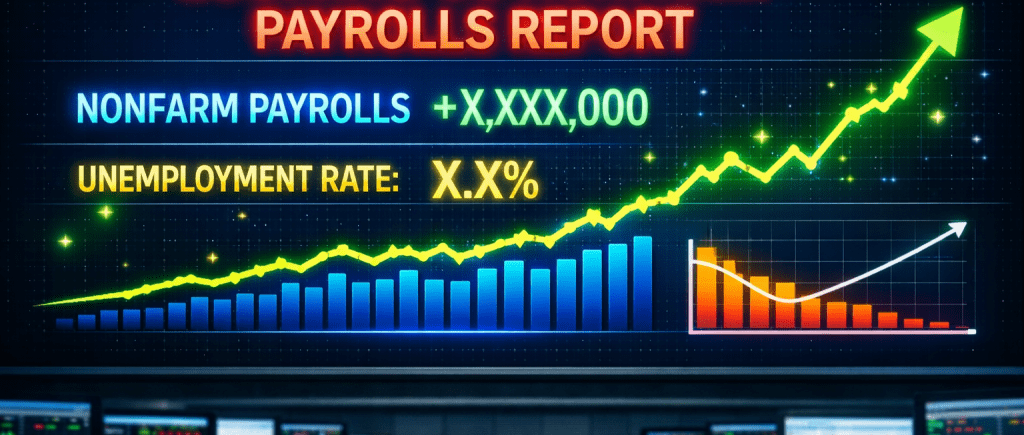
Global markets are heading into Friday’s closely watched U.S. nonfarm payrolls report with growing expectations that the American labor market may have performed better than many investors initially feared. After months of uncertainty tied to geopolitical tensions, elevated energy prices, and cautious corporate hiring, several fresh indicators now point to a potentially stronger employment reading for April.
Economists are broadly expecting the U.S. economy to add between 60,000 and 90,000 jobs in April, following March’s surprisingly strong gain of 178,000 positions. The unemployment rate is also expected to remain relatively stable near 4.3%, while wage growth continues to show resilience despite concerns about slowing economic momentum.
Fresh Economic Signals Boost Optimism
A series of recent labor-market indicators has helped improve sentiment ahead of the official report. Private-sector hiring data showed a noticeable rebound in April, while weekly jobless claims declined, suggesting layoffs remain relatively limited across major sectors of the economy.
Manufacturing activity remains mixed, but several business surveys indicate that parts of the industrial sector may be stabilizing after a difficult start to the year. Meanwhile, healthcare and service industries continue to support hiring, helping offset weakness in areas facing pressure from automation, higher borrowing costs, and slower global trade activity.
Consumer confidence data has also improved modestly, with more Americans expressing optimism about job availability and income stability compared with earlier in the year.
Why Markets Are Watching So Closely
The upcoming payrolls report carries major implications for financial markets because it could influence expectations surrounding future U.S. interest-rate decisions. A stronger-than-expected jobs report may reinforce the view that the Federal Reserve will keep interest rates elevated for longer, particularly as inflation pressures remain persistent.
At the same time, traders remain highly sensitive to geopolitical developments and volatile energy markets, both of which continue to shape broader investor sentiment worldwide.
Fears Rise as a Nervous Market Searches for Direction
While recent economic indicators have pointed to continued resilience in the U.S. labor market, investors remain cautious ahead of Friday’s closely watched nonfarm payrolls report. Expectations currently suggest the economy added between 60,000 and 90,000 jobs in April, following March’s stronger-than-expected gain of 178,000 jobs, while the unemployment rate is forecast to hold near 4.3%.
Fresh labor data has added to speculation that hiring may have remained firmer than anticipated. Private-sector payroll estimates showed an increase of roughly 109,000 jobs in April, while weekly jobless claims fell to around 189,000, signaling that layoffs remain relatively contained despite ongoing economic uncertainty.Still, fears surrounding slowing growth, elevated energy prices, and geopolitical tensions continue to weigh heavily on investor sentiment.
Markets are also trying to assess whether the Federal Reserve will maintain higher interest rates for longer if employment and wage growth remain strong.With volatility building across global financial markets, traders are increasingly viewing the upcoming payrolls report as a key test for the broader economy. A stronger-than-expected reading could reinforce expectations of prolonged monetary tightening, while weaker figures may intensify concerns about a sharper economic slowdown in the months ahead.