Noor Trends News, Technical Analysis, Educational Tools and Recommendations

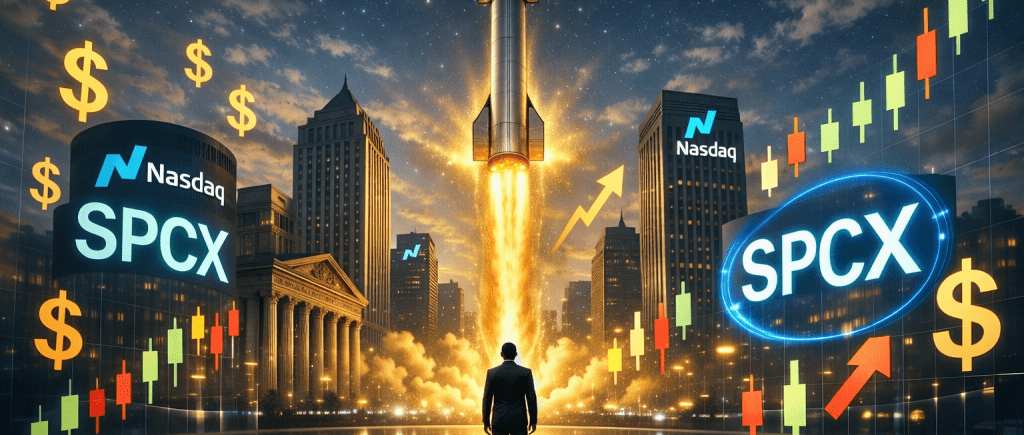
The most anticipated stock market debut in decades is finally happening. It is a moment investors have been waiting for. After years of speculation, Elon Musk’s space empire is officially heading to Wall Street. SpaceX filed its IPO prospectus with American regulators on May 20, 2026, setting the stage for what is widely expected to become the largest public offering in stock market history. The company plans to list on the Nasdaq under the ticker **SPCX**, with shares expected to begin trading on June 12.
Numbers That Break Every Record
SpaceX is targeting a raise of around $75 billion — more than triple the size of the previous biggest U.S. IPO ever recorded. Its valuation could reach as high as $2 trillion, placing it among the most valuable companies on the planet. To put that in perspective, no American tech company has ever gone public at anywhere near this scale.
A Business Growing Fast — and Spending Faster
The financial picture inside the prospectus is as dramatic as the ambition behind it. SpaceX generated $18.7 billion in revenue in 2025, a strong performance by almost any measure. Yet the company lost nearly $5 billion over the same period, with losses growing by another $4.3 billion in just the first three months of 2026.
The engine keeping the business running is Starlink, the company’s satellite internet service, which accounts for roughly 61% of total revenue and is the only division clearly in the black. Meanwhile, the AI and orbital data center division is spending at a ferocious pace, pouring billions into space-based computing infrastructure as SpaceX bets heavily on the future intersection of artificial intelligence and space technology.
One Man, 85% of the Vote
Perhaps the most striking detail in the filing has nothing to do with rockets or revenue. Musk will retain control of 85% of all shareholder voting rights, while simultaneously holding the roles of CEO, Chief Technology Officer, and Board Chairman. In practice, this means shareholders will have almost no ability to challenge or remove him. He would, quite literally, have to vote to fire himself.
The filing also reveals that SpaceX spent nearly $700 million purchasing products from Tesla — a company also run by Musk — between 2024 and 2025, including a significant number of Cybertruck vehicles. For investors, these kinds of cross-company transactions raise legitimate questions about where one business ends and another begins.
The Rocket That Everything Depends On
Behind the financial numbers lies the real gamble: Starship. SpaceX spent over $3 billion developing its giant next-generation rocket in 2025, and has already burned through nearly $1 billion more in early 2026. A critical test flight of a heavily redesigned version is underway right now, using new engines that have never been flown before. The program has a turbulent history, though recent launches have shown improvement.
If Starship works at scale, it transforms the economics of space entirely. If it doesn’t, the losses compound quickly.
Worth the Risk?
SpaceX is not a conventional investment. It is a long-horizon bet on commercial space, satellite internet, and AI infrastructure maturing into industries worth trillions. The governance is unusual, the losses are real, and the roadshow has not even begun yet.
But there is arguably no company in the world today combining this level of technological ambition with this degree of market dominance. The pricing is expected around June 11, with first-day trading set for June 12. Wall Street — and the world — will be watching.