Noor Trends News, Technical Analysis, Educational Tools and Recommendations

Reopening High-Stakes Economic Talks in Beijing
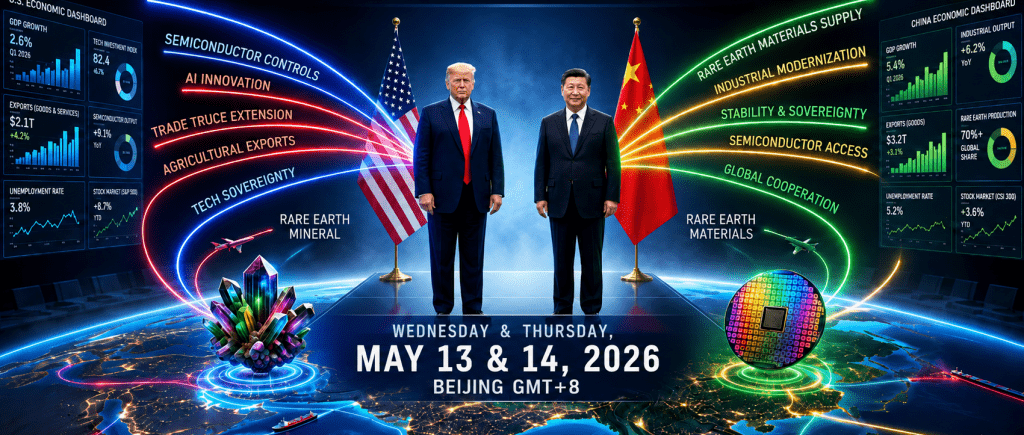
US President Donald Trump’s arrival in Beijing on Thursday, May 14, 2026, reignited one of the most closely watched geopolitical and economic dialogues of the decade. Meeting Chinese President Xi Jinping amid surging oil prices, global inflation, and renewed tariff disputes, the summit has become a defining moment for the world’s two largest economies.
The visit — the first by a sitting US president to China in nearly ten years — comes as financial markets reel from supply chain disruptions and uncertainty surrounding trade policy.
Trade War Pressure Pushes Washington and Beijing Back to the Table
After months of escalating tariff battles, both nations have returned to negotiations. During 2025, tariffs soared to historic levels, straining global commerce and investor confidence. This week’s talks produced a temporary reduction in duties, signaling a cautious step toward stabilization.
The renewed dialogue centers on market access, supply chain resilience, and cooperation in agriculture, energy, semiconductors, and artificial intelligence, all crucial pillars of modern economic recovery.
China at the Heart of America’s Economic Agenda
For Washington, Beijing is now central to its broader economic strategy. The US seeks expanded Chinese purchases of American agricultural and energy products to narrow the trade gap, while China aims for relief from restrictions on advanced chip technology. These discussions highlight how deeply intertwined trade, technology, and national security have become in shaping global economic power.
Oil Prices and the Iran Crisis Shape the Summit’s Urgency
The ongoing Middle East conflict has amplified the stakes. Elevated oil prices and potential disruptions through the Strait of Hormuz have made energy security a top priority. Both sides explored ways to stabilize oil flows and expand Chinese imports of US energy supplies — a move that could ease pressure on global markets and inflation.
AI, Chips, and Technology: The New Battleground
Technology competition dominates the summit’s agenda. Restrictions on semiconductor exports and access to high-end AI chips remain flashpoints. Business leaders accompanying the delegation underscore how economic diplomacy and tech innovation now move hand in hand.
Artificial intelligence, digital infrastructure, and supply chain independence are emerging as strategic priorities for both nations.
Global Markets React to Every Signal from Beijing
Investors worldwide are watching closely. Currency, commodity, and equity markets have all responded to the summit’s tone, with cautious optimism replacing earlier volatility.
Any progress on tariffs or cooperation could ease supply chain stress and boost confidence, while renewed confrontation risks reigniting global instability.
Geopolitical Shadows: Taiwan and Regional Tensions
Despite the economic focus, geopolitical friction remains. Taiwan continues to cast a shadow over US–China relations, with both sides seeking to avoid escalation while maintaining strategic leverage.
Regional security and global stability discussions reflect the delicate balance between economic collaboration and political rivalry.
A Summit That Could Reshape Global Economics
The Trump–Xi meeting is more than a diplomatic exchange — it’s a potential turning point for global trade and growth. With inflation pressures, energy shocks, and geopolitical uncertainty defining 2026, the world is watching whether this renewed dialogue can deliver lasting stability.
For now, cautious optimism prevails, but the true measure will be whether temporary agreements evolve into sustained economic cooperation.