Noor Trends News, Technical Analysis, Educational Tools and Recommendations

The US Treasury market — often viewed as the ultimate barometer of global financial health — is sending a powerful and uneasy message. Recent movements in government bond yields reveal a market struggling to make sense of a world shaped by persistent inflation, geopolitical tension, and an increasingly cautious central bank.
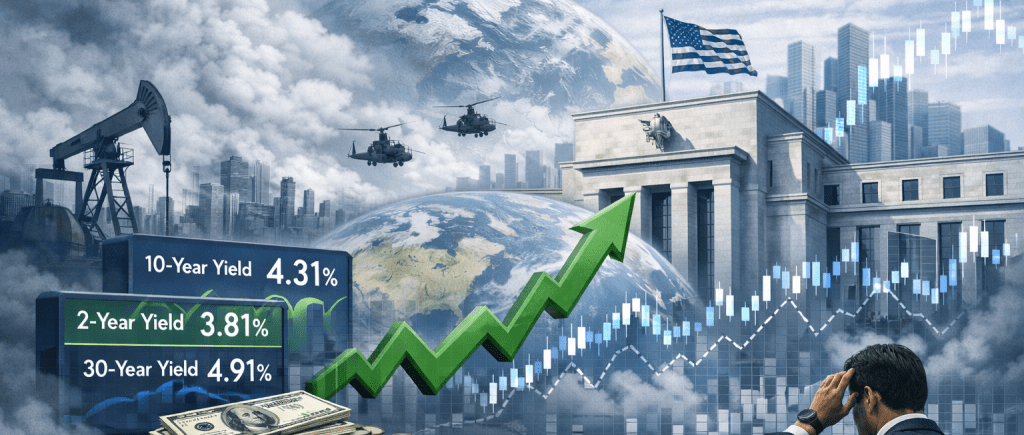
As of April 10, 2026, benchmark yields remain elevated: the 10-year Treasury stands at 4.31%, the 2-year at 3.81%, and the 30-year near 4.91%. These are not just numbers — they are signals. Signals that investors are demanding higher compensation to navigate a landscape filled with uncertainty and risk.
What Rising Yields Really Mean
At its core, a Treasury yield represents the return investors receive for lending money to the US government. When confidence is high and inflation is stable, yields tend to remain low. But when uncertainty rises — whether due to economic instability, inflation fears, or global conflict — investors demand higher returns.
That’s exactly what is happening now. The current rise in yields reflects a shift in sentiment: caution has replaced confidence, and risk is being priced in more aggressively than at any point in recent years.
Inflation Refuses to Fade
One of the biggest forces behind this shift is inflation. Price pressures have proven far more persistent than expected, fueled in large part by rising energy costs. Higher oil prices have filtered through the global economy, increasing the cost of transportation, production, and everyday goods.
For bond investors, inflation is a direct threat. It erodes the real value of fixed returns, making bonds less attractive unless yields rise to compensate. This dynamic has kept upward pressure on Treasury yields, even as hopes for stabilization briefly emerged earlier in the year.
Fed Caught in the Middle
The Federal Reserve now finds itself in a difficult position. On one side, inflation remains above target. On the other, economic momentum is showing signs of slowing. Normally, central banks can respond clearly — tightening policy to fight inflation or easing to support growth. But today’s environment offers no easy choice. Cutting rates too soon risks reigniting inflation, while keeping policy tight for too long could weaken the economy further.
This policy tension has added another layer of uncertainty to the bond market, leaving investors unsure about the future direction of interest rates.
The Return of a Dangerous Economic Mix
A troubling theme is beginning to take shape: the possibility of stagflation — a combination of slow growth and persistent inflation.
Markets are increasingly reflecting this concern. In a notable shift from historical patterns, government bonds are no longer acting as a reliable safe haven during times of geopolitical stress. Instead of buying bonds in moments of fear, investors are selling them — pushing yields higher — because the source of uncertainty is itself inflationary.
This behavior signals a deeper concern: that traditional financial relationships may be breaking down under current conditions.
Debt Pressures Are Adding Fuel
Another critical factor is the growing scale of government borrowing. As deficits expand, investors are becoming more sensitive to long-term fiscal sustainability.
Higher debt levels mean more bonds must be issued — and to attract buyers, yields need to be competitive. This is especially visible in long-term bonds, where investors are locking in returns for decades and demanding a premium for the risks involved.
The rise in the 30-year yield toward the 5% level reflects these long-term concerns more clearly than anything else.
Reading the Yield Curve
The relationship between short-term and long-term yields — known as the yield curve — offers valuable insight into market expectations.
Short-term yields tend to reflect expectations for central bank policy, while long-term yields capture broader views on inflation, growth, and fiscal health. The current pattern, where long-term yields are rising faster than short-term ones, suggests that investors are more worried about sustained inflation than an immediate recession. This shift indicates that markets expect challenges to persist rather than resolve quickly.
Geopolitic Factors Move Markets in Real Time
Global tensions, particularly in energy-sensitive regions, have become a direct driver of bond market movements.
Every development — whether escalation or de-escalation — now feeds almost instantly into expectations for inflation and economic stability. This has transformed Treasury yields into a real-time reflection of geopolitical risk, amplifying volatility and reducing predictability.
New Financial Reality
What emerges from all these signals is a clear conclusion: the global financial environment has fundamentally changed.
The era of ultra-low interest rates and predictable economic conditions is over. Borrowing costs are higher, inflation remains a persistent challenge, and uncertainty is shaping investor behavior in ways not seen for years.
For markets, businesses, and individuals alike, the message is straightforward — the road ahead will likely remain uneven, and financial conditions will stay tight for the foreseeable future.