Noor Trends News, Technical Analysis, Educational Tools and Recommendations

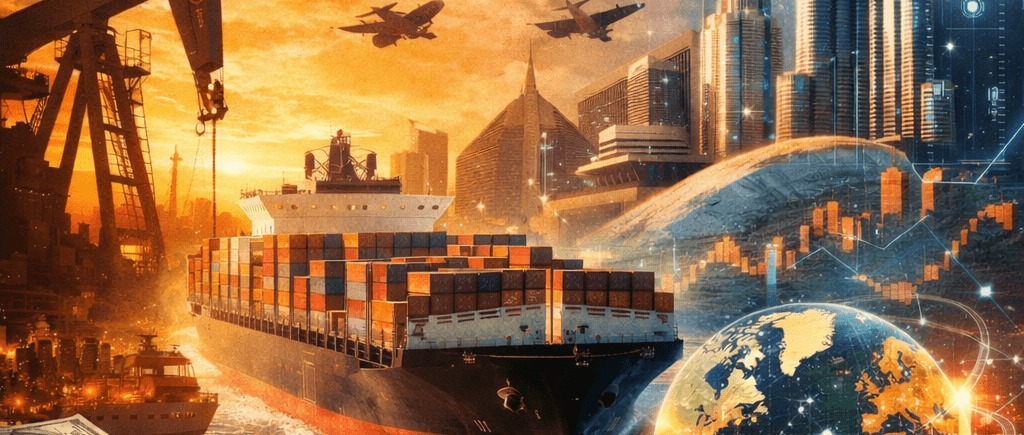
For decades, the Middle East was viewed mainly through the lens of energy exports. Today, that picture has changed dramatically. The Gulf region has evolved into a global force that not only supplies energy but also shapes financial markets, drives investment flows, and influences the direction of technological development.
What makes this transformation so significant is that the region is no longer just reacting to the global economy—it is actively helping build it. From massive investment funds to fast-growing innovation hubs, the Gulf has become deeply embedded in the world’s economic system.
From Energy Supplier to Global Investor
The Gulf’s financial power has expanded at an extraordinary pace. Sovereign investment institutions across the region now manage trillions of dollars in global assets, making them some of the most influential investors in the world. These funds are not limited to traditional sectors. They are active in technology, infrastructure, energy transition, artificial intelligence, and digital platforms. Their decisions can influence company valuations, funding cycles, and even the speed at which new technologies reach global markets.
In simple terms, when Gulf capital moves, global markets feel it.
The World’s Most Sensitive Trade Routes
Beyond finance, geography plays a critical role in the region’s global importance. Some of the world’s most vital shipping corridors pass through or near the Middle East, including narrow waterways that handle a significant share of global energy and trade flows.
Because of this, even the possibility of disruption in these areas can cause immediate reactions in global markets. Oil prices rise, shipping costs increase, and insurance premiums surge—even if actual supply has not yet been affected.
This extreme sensitivity highlights a key reality: the global economy depends heavily on stability in a very small number of critical routes.
When Uncertainty Matters More Than Reality
One of the most striking patterns in global markets is that expectations often matter more than events themselves. In the Middle East, even the risk of instability can trigger global reactions. Energy markets respond quickly to perceived threats, and financial systems adjust almost instantly to uncertainty. This creates a situation where tension alone—without any physical disruption—can influence prices, trade flows, and investment decisions worldwide.
The modern global economy is built on confidence, and uncertainty is often enough to weaken that foundation.
A Networked Global Economy
The Middle East is now deeply connected to global industries far beyond energy. Its investment institutions are major stakeholders in international companies, technology platforms, and financial systems.
At the same time, the region is building its own innovation ecosystem. Governments are investing heavily in artificial intelligence, digital infrastructure, and entrepreneurship, aiming to position their economies as both investors and creators in the global tech landscape. This dual role—both funding and building global systems—has made the region more influential than ever before.
Why Instability Has Global Consequences
If tensions in the region escalate, the effects would not remain local. Higher energy prices could contribute to global inflation, making it harder for economies to manage interest rates and growth. Supply chains could face higher costs, affecting everything from manufacturing to consumer goods.
Investment flows could also slow as uncertainty increases. Businesses tend to delay expansion during periods of geopolitical risk, which can reduce innovation and economic momentum across multiple sectors. The longer uncertainty lasts, the more these effects accumulate.
A Fragile but Powerful System
The modern global economy is highly interconnected and efficient—but also fragile. It depends on predictable trade routes, stable energy markets, and continuous capital movement. The Middle East sits at the center of many of these systems. As a result, its stability carries global importance far beyond its borders. What might appear as a regional issue can quickly become a worldwide economic concern.
The Bigger Picture
The key lesson is not just about one region, but about how interconnected the world has become. Energy, finance, and technology are now tightly linked across continents, and disruptions in one critical area can ripple outward quickly.
The Middle East’s growing role in global investment and trade means its influence will likely continue to expand. But it also means that stability in the region is not just a regional priority—it is a global necessity.
In today’s world, small shocks can travel fast. And in a system this connected, even the possibility of disruption can be powerful enough to move the entire global economy.