Noor Trends News, Technical Analysis, Educational Tools and Recommendations

Beyond Hormuz: How Global Trade Is Breaking Free from a Historically Strategic Chokepoint
The world’s reliance on the Strait of Hormuz—a narrow 21-mile maritime corridor—has long been a silent vulnerability. Nearly one-third of seaborne oil, one-fifth of liquefied natural gas, one-third of global fertilizer shipments, and half of sulfur exports pass through this strategic bottleneck. Recent military escalations with Iran since late February 2026 have brought the vulnerability into sharp focus, with shipping traffic plunging from 129 vessels per day to as few as 4 in some instances.
While the immediate impact on global energy and food prices has been severe, the crisis is also accelerating a historic shift. Gulf states, particularly Saudi Arabia and the UAE, are now rapidly building alternative infrastructure to bypass the strait entirely. This evolution signals a future in which global trade in energy and essential commodities will no longer hinge on Hormuz.
Pipelines Leading the Shift
Among the most significant alternatives are land-based pipelines:
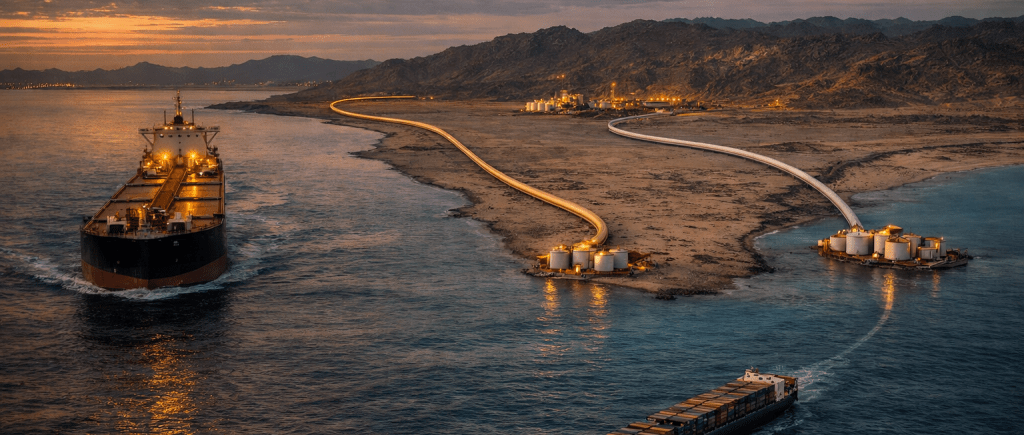
Saudi East-West Pipeline (Petroline): Stretching from the oil-rich eastern fields to the Red Sea port of Yanbu, it can transport 5–7 million barrels per day, allowing massive exports without passing through Hormuz.
Abu Dhabi Crude Oil Pipeline (ADCOP): Linking inland fields to Fujairah port on the Gulf of Oman—outside the strait—this pipeline has already reached full capacity amid the current disruption.
Beyond these, discussions are underway to develop additional pipelines and overland and maritime transport corridors, with projected costs in the tens of billions of dollars. Proposals include expansions through Turkey and other strategic routes. These initiatives are more than emergency measures—they represent a long-term strategy to secure global energy and food flows, especially for Asia, which imports the bulk of these resources.
A Structural Shift in Global Trade
The current Hormuz crisis, despite its high cost, is acting as a catalyst for change. Within a few years, the strait will no longer serve as the “main artery” of global trade. Countries are learning fast, investing in contingency routes, and building resilience that reduces exposure to geopolitical pressure. This transformation is likely to recalibrate regional power dynamics, diminishing the leverage previously afforded by control over the narrow waterway.
The lesson is clear: the future of global trade is becoming more flexible, diversified, and resilient. Hormuz may remain strategic, but it is no longer indispensable.