Noor Trends News, Technical Analysis, Educational Tools and Recommendations

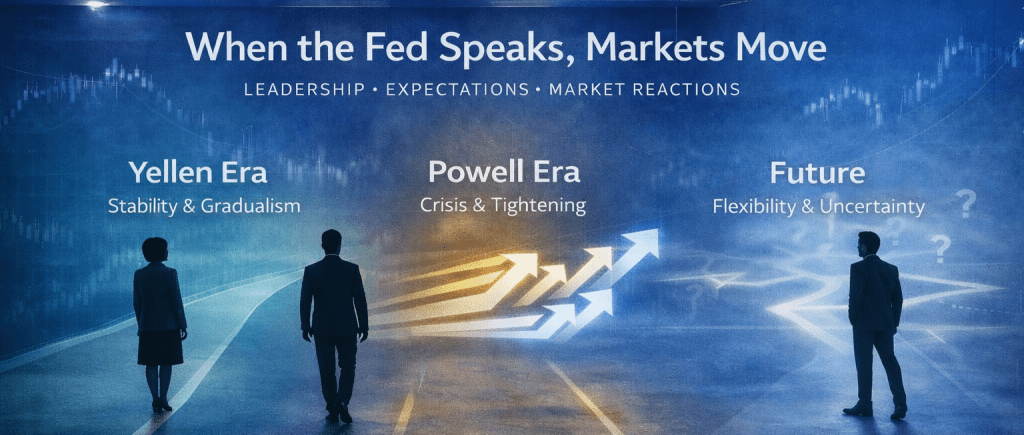
Markets don’t just react to interest rates—they react to the people setting them. Over the past decade, the Federal Reserve has shown that monetary policy is not only about data and models, but also about leadership style, communication strategy, and institutional philosophy. From post-crisis recovery to the pandemic shock and the inflation surge that followed, the Fed’s voice has evolved alongside the challenges it faced. The contrast between Janet Yellen and Jerome Powell, along with the debate surrounding potential future leadership such as Kevin Warsh, highlights how expectations around inflation, interest rates, and economic growth are shaped as much by communication as by policy decisions.
Stability and Labor Focus: Yellen’s Data-Driven Gradualism
When Janet Yellen took office in 2014, the U.S. economy was still recovering from the global financial crisis. Inflation remained subdued, and labor market slack was a central concern. Yellen approached monetary policy with a strong academic foundation, emphasizing empirical evidence and consensus-building within the Federal Open Market Committee. Her strategy centered on gradualism. Interest rate increases were carefully timed and clearly communicated, allowing financial markets to adjust smoothly. Forward guidance became a key tool, shaping expectations about the future path of policy.
By reinforcing transparency, Yellen reduced uncertainty premiums and supported steady economic expansion. Equally important was her focus on employment as a driver of inflation dynamics. Rather than reacting aggressively to early signs of price pressures, she prioritized a broad and inclusive labor market recovery. This approach helped anchor expectations and contributed to a period of relatively low market volatility.
Crisis Response and Inflation Control: Powell’s Adaptive Playbook
Jerome Powell inherited a stronger economy in 2018, but his tenure quickly became defined by crisis management. Unlike his predecessor, Powell brought a background rooted in financial markets and public service rather than academia, shaping a more pragmatic and flexible approach to policy. The COVID-19 pandemic marked a decisive turning point. The Fed rapidly cut interest rates to near zero and deployed large-scale asset purchases to stabilize financial markets and restore liquidity. These measures helped prevent a deeper financial crisis and supported the recovery.
However, the post-pandemic period introduced a new challenge: a sharp and persistent rise in inflation. Between 2021 and 2023, the Fed shifted decisively, implementing one of the most aggressive tightening cycles in decades. Rate hikes were delivered at an accelerated pace, signaling a firm commitment to restoring price stability—even at the cost of slower growth.
Powell’s communication style played a central role in this transition. Moving away from the opaque language historically associated with central banking, he emphasized clarity and accessibility.
Press conferences became more direct, focusing on explaining trade-offs between inflation control and economic activity. This approach helped anchor expectations during a period of heightened uncertainty, even as markets adjusted to tighter financial conditions.
Possible Shift Ahead: Flexibility and Institutional Debate
Looking ahead, discussions around potential future leadership—including figures such as Kevin Warsh—reflect a broader debate about the Fed’s next phase. While no appointment is confirmed, Warsh is often associated with a philosophy that emphasizes flexibility and internal debate over detailed forward signaling.
This perspective challenges the current reliance on explicit guidance tools such as rate projections. Critics argue that excessive transparency can constrain policymakers, limiting their ability to respond swiftly to changing economic conditions. A more flexible approach would prioritize adaptability, allowing the Fed to react dynamically to shifts in inflation, labor markets, and global risks.
Such a transition would have meaningful implications for financial markets. Reduced forward guidance could increase uncertainty around the future path of interest rates, potentially leading to higher volatility. At the same time, it could enhance the Fed’s responsiveness in an environment where economic shocks are becoming more frequent and less predictable.
Leadership, Expectations, and Market Behavior
The evolution from Yellen’s structured transparency to Powell’s adaptive crisis management—and the possibility of a more flexible future approach—underscores a critical reality: monetary policy operates as much through expectations as through actions.
Interest rates influence borrowing costs, investment decisions, and asset valuations, but expectations about those rates often matter even more. Clear communication can stabilize markets by reducing uncertainty, while strategic ambiguity can preserve policy flexibility at the cost of predictability.
This balance lies at the core of the Fed’s credibility. Too much rigidity risks policy mistakes in a rapidly changing environment. Too little guidance, however, can leave markets guessing—amplifying volatility and weakening the transmission of policy decisions.
When the Fed Speaks, Markets Listen and React
The Federal Reserve’s influence extends far beyond its control of interest rates. Its leadership shapes how inflation risks are perceived, how financial conditions evolve, and how confidently businesses and households make decisions.
Janet Yellen’s era demonstrated the power of transparency in anchoring expectations during recovery. Jerome Powell’s tenure highlighted the importance of flexibility and decisive action in times of crisis and inflationary pressure. The debate around future leadership points to a potential shift toward greater adaptability, even if it comes with reduced predictability. The real challenge for the Fed is not simply choosing between transparency and flexibility—it is managing the trade-off between them. Because in modern monetary policy, what the Fed says can move markets just as much as what it does.